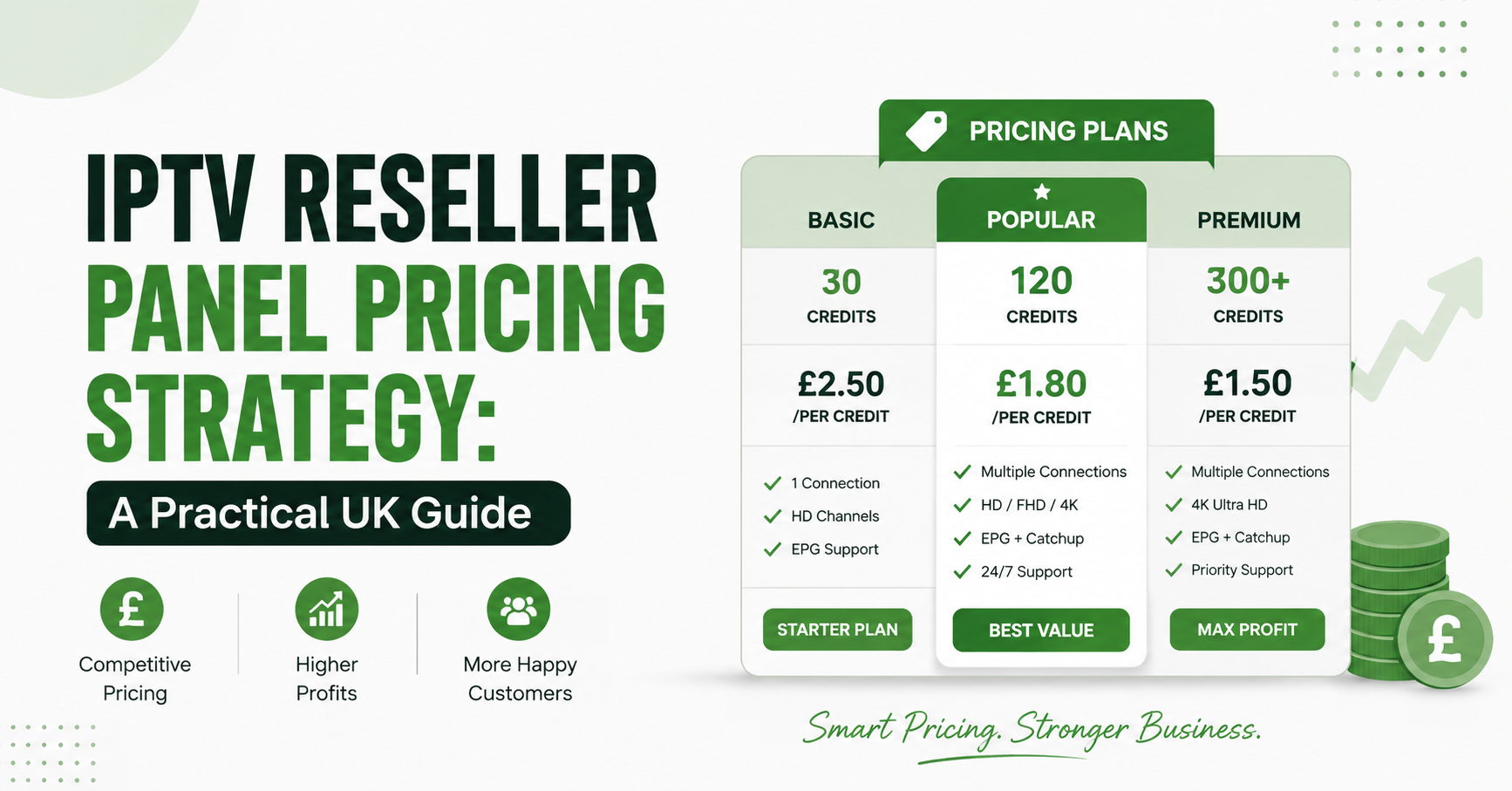

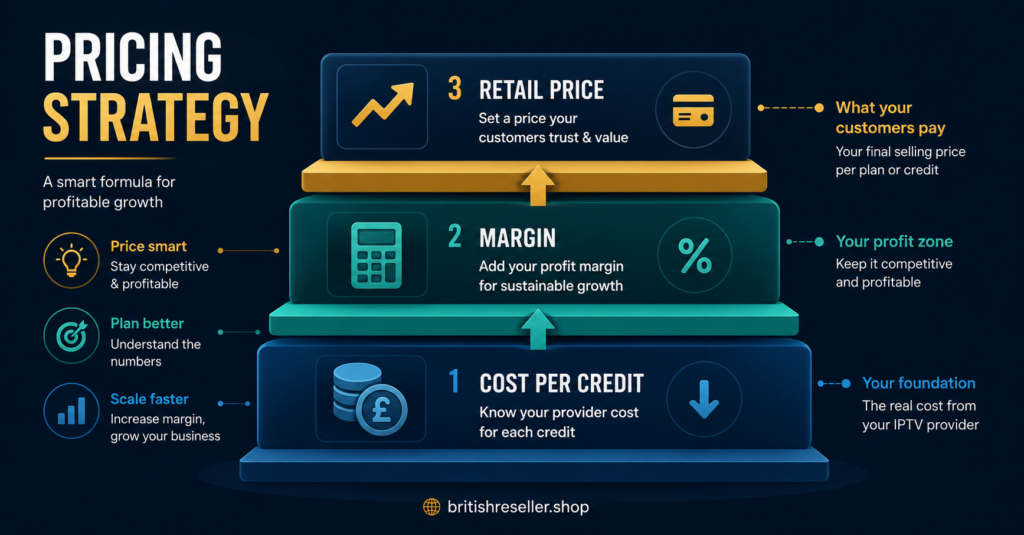
Getting an IPTV Reseller Panel Pricing Strategy right comes down to one core decision: pricing your service so the margin between what you pay per credit and what you charge customers survives real costs like refunds, payment fees and support time, rather than just looking good on a landing page. Too many resellers copy a competitor’s headline price, forget that credits, chargebacks and customer churn all eat into that number, and end up working hard for very little actual profit. A workable pricing strategy starts with your true cost per customer month, adds a realistic buffer for the costs that don’t show up in a credit invoice, and only then looks at what the market will bear.
[ez-toc]
What Actually Shapes an IPTV Reseller Panel Pricing Strategy
Before picking a number, it helps to separate the things you can control from the things you can only respond to. You control your credit cost, your package sizes, your refund policy and how much support time you build into each sale. You don’t control what competitors charge, how often a customer’s device gives them trouble, or whether a payment processor changes its fees mid-year.
A pricing strategy that only looks at the first group tends to hold up. One that reacts purely to the second group, chasing whatever a rival reseller advertises this week, usually doesn’t. If you’re new to the credit side of the business, it’s worth working through the pricing and credit calculation guide before setting any customer-facing price, since the retail number only makes sense once you understand how credits convert into months of service.
Pro tip: Write your true cost per customer month on paper before you write a single retail price. Include the credit cost, an estimated refund rate and a rough hourly value for support time. That number, not the competitor’s price, is your floor.
Start With Credit Cost, Not With the Market
Every IPTV reseller panel converts credits into customer months at a fixed or tiered rate. On packages like Smark’s published 120-credit tier, credits are priced at £1.50 each, with one credit typically covering one customer for one month. A 12-month customer line at that rate would use twelve credits, or £18 in credit cost, before you’ve added anything for your own time or risk.
That £18 is not your break-even price. It’s the floor beneath your floor. Payment processing typically takes a percentage off each transaction, some proportion of customers will ask for a refund or a chargeback, and every support ticket takes time that has a cost even if you don’t invoice for it separately. A pricing strategy that stops at “credit cost plus a bit” tends to look profitable on a spreadsheet and feel thin in a bank account.
Common Pricing Approaches
| Pricing Model | Best For | Limitation |
|---|---|---|
| Flat retail price across all terms | New resellers wanting simplicity | Doesn’t reward longer commitments or discourage single-month churn |
| Tiered discount by subscription length | Encouraging 6 or 12-month sign-ups | Requires careful margin checking on the longest terms |
| Volume-based reseller-to-sub-reseller pricing | Resellers running their own sub-reseller network | Needs clear written terms to avoid disputes over margin |
Why Undercutting the Market Rarely Works Long Term
It’s tempting to look at a competitor’s advertised price and shave a pound or two off it. In a market where several resellers may be buying credits from similar suppliers at similar rates, that approach tends to compress everyone’s margin without actually growing anyone’s customer base much, because rivals can usually match the cut.
A more durable IPTV Reseller Panel Pricing Strategy treats price as one part of the offer, alongside response time, clear refund terms, and honest communication about what the service can and can’t guarantee. Customers who choose a reseller purely on price are also the ones most likely to leave the moment a cheaper option appears, which increases churn and makes your customer base harder to forecast.
Pro tip: If you’re tempted to match a competitor’s price exactly, check whether they’re also matching their refund policy, support hours and package structure. A lower price with worse terms isn’t really a lower price, it’s a different product.
Packaging: How Bundle Size Affects Your Strategy
Package size does more than set a headline number. Buying credits in larger blocks, such as moving from a 120-credit starter tier to a 480-credit tier, often brings the per-credit rate down, which changes what you can afford to charge without losing margin. But larger packages also tie up more working capital and assume you have the customer demand to use those credits before they’re needed elsewhere.
Resellers sometimes buy a large package because the per-credit saving looks attractive, then find themselves sitting on unused capacity for months. Unused credits are not guaranteed future income, they’re stock that’s already been paid for. A sound pricing strategy sizes package purchases against real, evidenced demand rather than the biggest discount available.
Sub-resellers face a related but distinct version of this problem. If you allocate credits downward to sub-resellers, your pricing to them needs enough margin built in to cover your own costs while still leaving them room to profit when they sell to their own customers. Details on setting that structure up are covered in the sub-reseller account setup guide.
Common Mistakes That Undermine a Pricing Strategy
Most pricing problems don’t come from picking the wrong number outright. They come from decisions made elsewhere in the business that quietly erode whatever margin the price was supposed to protect.
Mistake and Better Approach
| Mistake | Better Approach |
|---|---|
| Pricing only against credit cost, ignoring refunds and support time | Build a small buffer into retail price for known cost categories |
| Offering unlimited free trials without a follow-up process | Limit trial length and track conversion so it’s a marketing cost, not an open-ended expense |
| Changing prices frequently without notice | Communicate any price change clearly in advance and honour existing terms |
| Copying a competitor’s price without checking their terms | Compare the whole offer, not just the number, before adjusting your own |
Frequent, unexplained price changes are particularly damaging. Customers on IPTV services already tolerate a certain amount of uncertainty around streaming quality and device compatibility. Unpredictable pricing on top of that erodes trust faster than almost anything else, and trust is a large part of what keeps a reseller business stable through the inevitable technical hiccups.
Using an Illustrative Provider Example: Skip This
To see how these principles apply in practice, take an illustrative provider such as Skip This. Whatever the advertised credit rate happens to be, the same evaluation applies as it would to any panel: check the true credit-to-month ratio, confirm whether credits expire, and work out your break-even retail price before advertising anything to customers. Skip This is not being described here as the cheapest, the most reliable or the best supported option, only as an example of the same pricing exercise any UK IPTV Panel reseller should run before signing up with a supplier.
The evaluation questions are the same regardless of which panel you’re comparing:
- What does one credit actually buy, in months, for one customer?
- Does the advertised per-credit rate apply at your intended package size, or only at a higher tier?
- Are credits described as expiring or non-expiring, and is that written into the terms?
- What refund or dispute process applies if the supplier’s service changes?
If a provider’s answers to these questions aren’t clear or documented, that uncertainty itself is a cost, even though it won’t show up as a line item anywhere.
Reseller Guidance: Setting Your Own Retail Structure
As a reseller, your pricing strategy needs to account for the fact that you’re the one absorbing customer-facing risk. If a stream drops or a device stops working, the customer contacts you, not the panel supplier. That support burden should be reflected somewhere in your pricing, even if it’s not itemised separately on an invoice.
A tiered structure, where longer subscriptions cost less per month than single-month purchases, tends to work well because it rewards commitment while still letting new customers try the service at a manageable price point. Just make sure the longest tier still clears your true cost floor once refunds and support time are factored in. For a wider look at building demand around whatever pricing structure you settle on, the IPTV marketing strategy guide covers acquisition approaches that don’t rely on constantly undercutting on price.
Sub-Reseller Guidance: Pricing Down the Chain
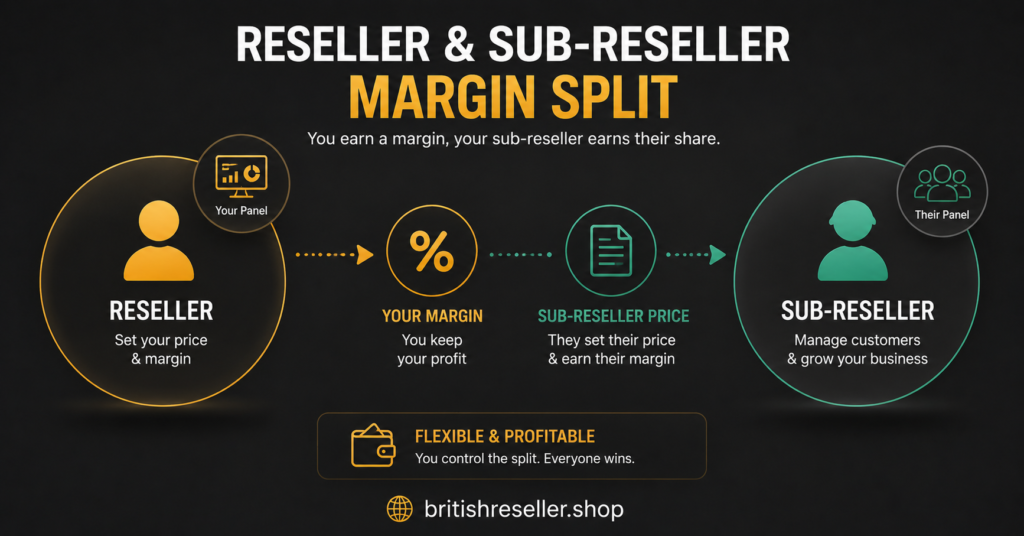
If you operate sub-reseller accounts, your pricing strategy has an extra layer. You need a margin over your own cost when allocating credits to sub-resellers, but that margin also needs to leave enough room for the sub-reseller to price competitively to their own customers. Squeeze that margin too tightly and sub-resellers either can’t compete locally or start looking for a different parent reseller.
Document the wholesale rate you offer sub-resellers in writing, along with any minimum volume expectations and what happens if a sub-reseller’s account falls into arrears. Ambiguity here tends to surface as disputes later, usually at the worst possible time.
When to Revisit Your Pricing Strategy
Pricing isn’t a one-time decision. Credit costs from suppliers can change, payment processing fees can shift, and customer expectations move as the wider market changes. Revisit your numbers at least twice a year, and immediately after any change to your credit cost or refund rate.
A simple trigger list helps avoid reacting too late:
- Your credit cost per package changes by more than a small percentage
- Refund or chargeback rates rise noticeably over a few months
- A competitor’s structural offer changes, not just their headline price
- Your support time per customer increases due to device or app changes
Visible FAQ
What is the simplest way to start an IPTV Reseller Panel Pricing Strategy?
Work out your true cost per customer month first, including credit cost, an estimated refund allowance and support time, then set retail prices above that floor rather than starting from what competitors charge.
Should I always match a competitor’s advertised price?
Not automatically. Compare their full offer, including refund terms and support quality, before assuming a price match makes sense for your business.
Does buying a larger credit package always improve my pricing strategy?
Only if you have evidenced customer demand to use the credits. A lower per-credit rate on unused stock does not improve profitability.
How often should I review my pricing?
At minimum twice a year, and immediately after any change to your credit cost, refund rate or payment processing fees.
Is a tiered pricing structure better than a flat rate?
Tiered pricing that discounts longer subscriptions often works well because it rewards commitment, but every tier still needs to clear your true cost floor.
How does sub-reseller pricing affect my overall strategy?
You need margin over your own cost when pricing to sub-resellers, but not so much that they can’t price competitively to their own customers.
Conclusion
A workable IPTV Reseller Panel Pricing Strategy isn’t built from a single competitive number, it’s built from knowing your true cost per customer month, pricing above that floor with a sensible buffer, and reviewing the numbers regularly rather than reacting to whatever a rival advertises this week. There’s no guaranteed margin in this business, and refunds, support time and payment fees will always take a bite out of the gap between credit cost and retail price. Start with the fundamentals covered in the earnings and profit guide, document your terms clearly for customers and sub-resellers alike, and treat pricing as something you revisit, not something you set once and forget.
Reseller Checklist
- Calculate your true cost per customer month, including credit cost, refund allowance and support time
- Set retail prices above that floor, not against a competitor’s headline number
- Confirm whether credits expire and whether the per-credit rate changes at different package sizes
- Document wholesale pricing terms in writing for any sub-reseller accounts
- Review pricing at least twice a year and after any change to credit cost or fees
- Avoid frequent, unexplained price changes that damage customer trust