
To Setup Sub-Reseller Accounts & Manage Credits properly, you create a separate panel login under your own account, hand it a fixed block of credits rather than open access, and set permissions that control exactly what that person can and cannot do with your customers. The account should never share your master login or draw credits without a limit. Everything below explains how to configure that safely, what to watch for once it is running, and where most resellers get it wrong.
[ez-toc]
What a Sub-Reseller Account Actually Is
A sub-reseller account is a smaller version of your own UK reseller panel, sitting underneath it. Instead of giving someone your username and password, you create them a separate login with its own credit balance, its own customer list, and its own set of permissions. They can create, extend, or manage lines for their own customers, but they never see your full account or your other sub-resellers.
Most IPTV panel software supports this natively, though the exact wording varies. Some call it a sub-panel, others a sub-account or a nested reseller. The mechanics are usually similar: you allocate credits from your own balance into theirs, and every line they generate deducts from that allocation rather than yours directly.
This matters for UK IPTV reseller operations in particular, because a lot of growth in this space comes from word of mouth rather than paid advertising. Someone who already has ten or fifteen customers of their own often wants to run their own small operation instead of just referring people to you. A sub-reseller account lets you support that without handing over control of your business.
Why Resellers Add Sub-Resellers in the First Place
The honest reason is usually one of two things. Either you have more demand than you can personally handle, or someone you know already has a customer base and wants in on the margin rather than working for a flat referral fee.
Sub-reseller structures also spread the support load. If a sub-reseller has twenty customers messaging them directly about buffering or login issues, that traffic never reaches you. You only get involved when the sub-reseller genuinely cannot resolve something themselves, which is a much smaller volume of tickets.
Pro tip: Before creating a sub-reseller account for someone, ask them to describe how they plan to price and support their own customers. Their answer tells you more about whether they will be reliable than any conversation about credit volume ever will.
Setup Sub-Reseller Accounts & Manage Credits: The Step-by-Step Process
This is the part most panel dashboards handle in a similar order, even if the button labels differ slightly between providers.
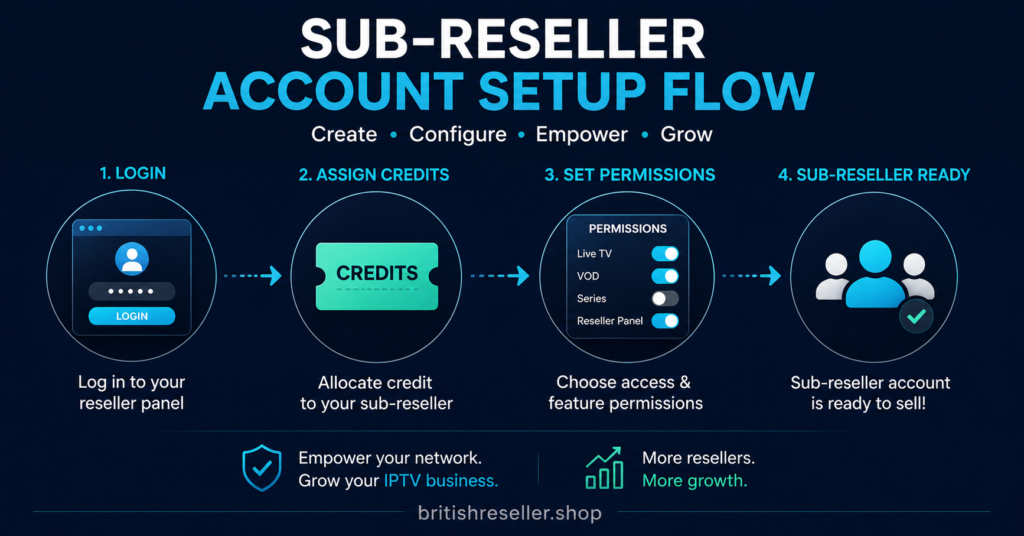
- Log into your reseller dashboard and find the sub-reseller or sub-account creation option, usually under account management or user management.
- Create the login with a username and password separate from your own. Never reuse your master credentials for a sub-account.
- Allocate a starting credit block. Choose a fixed number rather than granting continuous access to your full balance.
- Set permissions. Decide whether they can create trials, delete lines, change bouquets, or only create and extend existing customers.
- Confirm visibility limits. Sub-resellers should only see their own customers, never your full customer list or other sub-resellers underneath you.
- Test the account yourself by logging in as them, or watching them create a first line, before handing it over fully.
- Document the terms in writing, even informally: credit price, top-up process, what happens if they stop paying, and who owns the customer relationship if the arrangement ends.
That last step gets skipped constantly, and it is usually the one that causes the most friction later.
Setting Permissions Without Giving Away Control
Permissions are where a lot of reseller-to-sub-reseller relationships go wrong, usually because the reseller either grants too much access out of trust, or too little and the sub-reseller cannot actually run their business.
A workable middle ground usually looks like this: the sub-reseller can create lines, extend existing customers, and issue a capped number of free trials, but cannot delete their own credit history, change their own credit allocation, or see anyone else’s account. Some panels also let you restrict which bouquets or packages a sub-reseller can sell, which is useful if you want to keep certain packages exclusive to your own direct sales.
| Permission Type | What It Allows |
|---|---|
| Create and extend lines | Standard day-to-day account management for their customers |
| Free trial issuing | Lets them convert prospects without asking you each time |
| Bouquet selection | Controls which packages they can sell to their own customers |
| Credit self-top-up | Higher risk; usually better handled manually by you |
Pro tip: Turn off any option that lets a sub-reseller change their own credit balance. Top-ups should always route through you, even if that adds a small delay, because it is the one control that protects your margin.
Managing Credits Once the Account Is Live
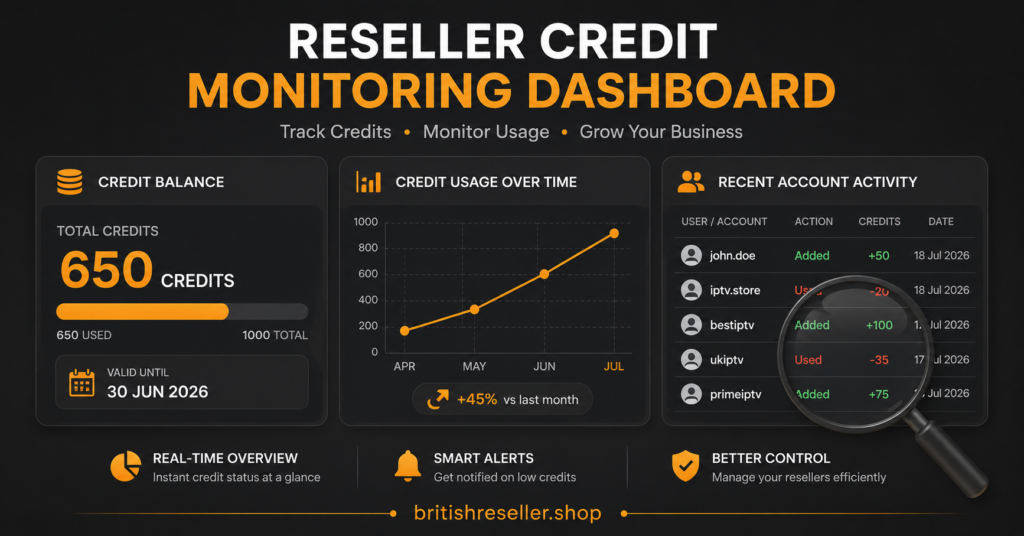
Credits are the part of this that actually needs ongoing attention, not just a one-time setup. A reseller dashboard typically shows a running balance for each sub-account, and it is worth checking that regularly rather than assuming it will flag problems on its own.
A few patterns are worth watching for. A sub-reseller burning through credits far faster than their customer count would suggest may be creating trial accounts they are not tracking, or reselling at a scale beyond what they originally told you. A sub-reseller who never top-ups, on the other hand, may simply have a small customer base, or may be struggling to sell and worth a conversation before the relationship quietly fades out.
Set a rhythm for top-ups rather than reacting to each request individually. Weekly or fortnightly reviews of sub-reseller balances make it easier to spot a business that is genuinely growing versus one that has stalled.
Basic Setup vs a Better Setup
| Area | Basic Setup | Better Setup |
|---|---|---|
| Credit allocation | Open access to your balance | Fixed, capped block per top-up |
| Permissions | Shared master login | Separate account with limited rights |
| Terms | Verbal agreement only | Written price, top-up, and exit terms |
| Monitoring | Checked only when something breaks | Reviewed on a set schedule |
Sub-Reseller Guidance: Margins and Dependency
If you are the sub-reseller rather than the one setting the account up, the maths only works if the margin between what you pay per credit and what you charge your customers actually covers your time and support effort. It is worth asking your parent reseller directly what happens to your customer base if the arrangement ends, since that is the single biggest risk in this structure. Ownership of the customer relationship should be clear before you start selling, not after a dispute.
Support responsibility is the other detail worth pinning down early. Some parent resellers expect you to handle every customer issue yourself and only escalate genuine outages. Others are more hands-on. Neither approach is wrong, but you want to know which one you are working under.
Reseller Guidance: Documentation and Escalation
For the reseller managing sub-accounts, the operational habit that pays off most is keeping a simple record: who each sub-reseller is, their credit price, their top-up pattern, and the date the account was created. This sounds basic, but reseller businesses that grow past three or four sub-accounts without any documentation tend to lose track of who owes what, and that is where disputes start.
Escalation paths matter too. Decide in advance what counts as an issue a sub-reseller should handle themselves versus one that needs to come to you, such as a server-wide outage rather than an individual customer’s device problem.
Common Mistakes When Adding Sub-Resellers
Sharing a single login between yourself and a sub-reseller is the most common one, because it removes your ability to see who did what if a dispute arises. Granting unlimited credit access is a close second, since it turns a small misunderstanding into a real financial loss.
Skipping written terms is another recurring issue. A quick message confirming the credit price, the top-up process, and what happens if either side wants to stop is enough. It does not need to be a formal contract, but it needs to exist somewhere both people can refer back to.
Finally, treating every sub-reseller the same regardless of how they perform is a missed opportunity. Someone who has consistently paid on time and grown their customer base for six months is a different risk profile to someone who joined last week, and your permissions or credit terms can reflect that.
Verified operational guidance and further reading on how these panels function can be found on the how IPTV reseller panels work page, and general reseller support topics are covered on the site’s blog section. For a broader look at reseller panel structures across different providers, britishreseller.com also covers how credit systems typically work. As an illustrative comparison point for how UK-facing reseller sites present this information, britishseller.co.uk is one example worth reviewing.
Where IPTV Sub-Reseller Structures Fit Legally
IPTV itself is simply a delivery method, streaming television over the internet rather than through satellite or aerial. That part is not in question anywhere. What determines legality is whether the content being distributed through any given panel is properly licensed, and that responsibility sits with whoever is distributing it, at every level of a reseller and sub-reseller chain. Anyone setting up a sub-reseller structure should be clear-eyed about this rather than assuming a professional-looking panel or a working payment system settles the question. If you are unsure how this applies to your specific situation, that is a conversation for a solicitor rather than a support ticket.
Frequently Asked Questions
Can a sub-reseller see my other sub-resellers or my main customer list?
No, not if permissions are set up correctly. A sub-reseller account should only show their own customers and their own credit balance, not yours or anyone else’s underneath you.
How many credits should I give a new sub-reseller to start?
There is no fixed number that suits everyone. A smaller starting block, reviewed and topped up once they show consistent activity, is generally lower risk than a large allocation upfront.
What happens to a sub-reseller’s customers if the arrangement ends?
This depends entirely on what you agreed at the start. It is worth deciding and writing down who owns the customer relationship before the account is created, not after a dispute.
Can I take away a sub-reseller’s permissions later?
Most panels allow you to adjust or revoke permissions at any point, including disabling the account entirely if needed.
Is it safe to let a sub-reseller top up their own credits automatically?
It carries more risk than manual top-ups, since it removes one of the few controls you have over how quickly your credit balance is consumed. Many resellers prefer to keep top-ups manual for this reason.
Do sub-reseller accounts cost extra on top of normal reseller credits?
This varies by provider, so it is worth confirming directly with whoever supplies your panel rather than assuming.