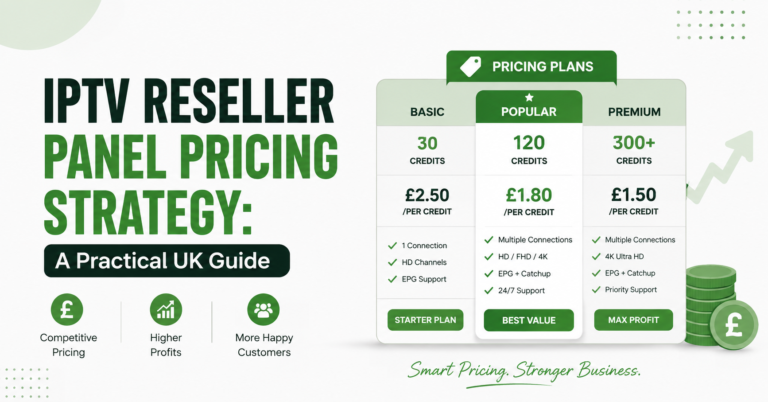

How Much Can You Earn Profit as an IPTV Reseller in UK (2026) comes down to a simple sum: what you charge customers, minus what your credits cost, multiplied by how many people actually stay subscribed. There is no fixed salary here. A reseller with ten steady customers might clear a modest side income each month. One with a few hundred, run properly, is looking at a genuine business. The number that matters most isn’t your price list, it’s how many of those customers renew.
[ez-toc]
Why “How Much Do IPTV Resellers Make” Has No Single Answer
Search for this question and you’ll find people quoting confident monthly figures as if reselling worked like a salaried job. It doesn’t. An IPTV Panel reseller isn’t paid a wage. You’re running a small subscription business where income scales directly with two things you control (how many customers you have, and what you charge them) and one thing you only partly control, which is how many of them come back next month.
That last part is where most of the guesswork online falls apart. A reseller with 50 customers paying a mid-range monthly price and a reseller with 50 customers who churn every six weeks are not making the same money, even though their customer count looks identical on paper.
The Basic Reseller Maths
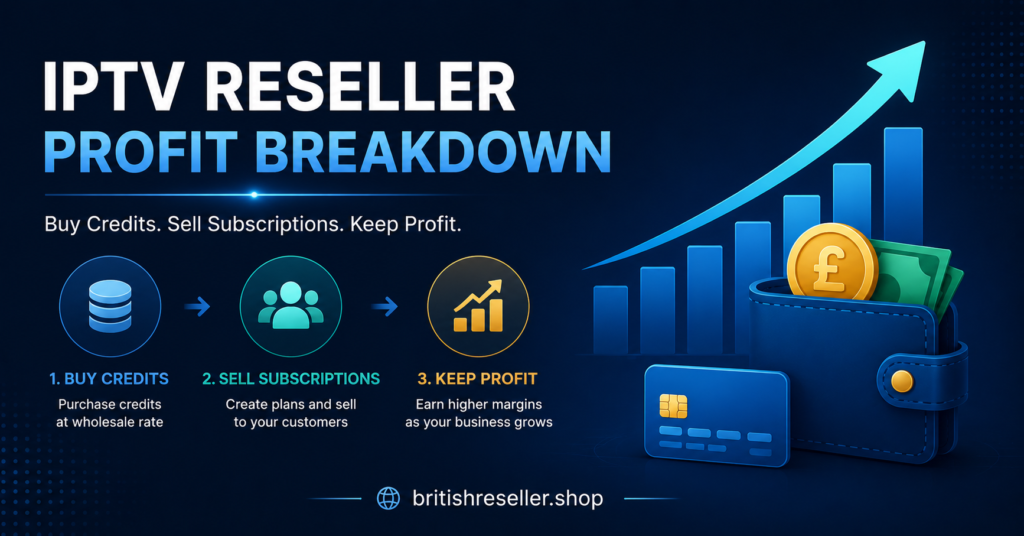
The mechanics are straightforward once you strip away the sales talk. You buy credits from a provider, typically at a wholesale rate. Each credit covers one customer for a set period, often a month. You then set your own retail price and keep the difference.
So if a credit costs you a fixed wholesale amount and you sell that month’s access for a higher retail price, your gross margin on that single sale is the gap between the two. Multiply that gap by the number of active, paying customers you have in any given month, and you get your gross monthly income before costs like support time, marketing, or any tools you use to run the business.
This is why the honest answer to how much resellers earn always starts with “it depends on your numbers,” not a headline figure.
What Actually Moves the Number
Pricing decisions
Undercutting every competitor feels like a fast way to win customers, but it usually attracts the least loyal ones, the people who leave the moment somebody else drops their price by a pound. Pricing close to the going market rate and competing on service quality tends to hold customers longer, which matters more to your total earnings than the price itself.
Customer volume
More customers means more potential income, but only if you can actually service them. A reseller juggling 200 customers alone, answering messages at midnight and losing track of who’s owed a renewal reminder, often earns less per customer than someone running a tighter operation with 60.
Renewal rate
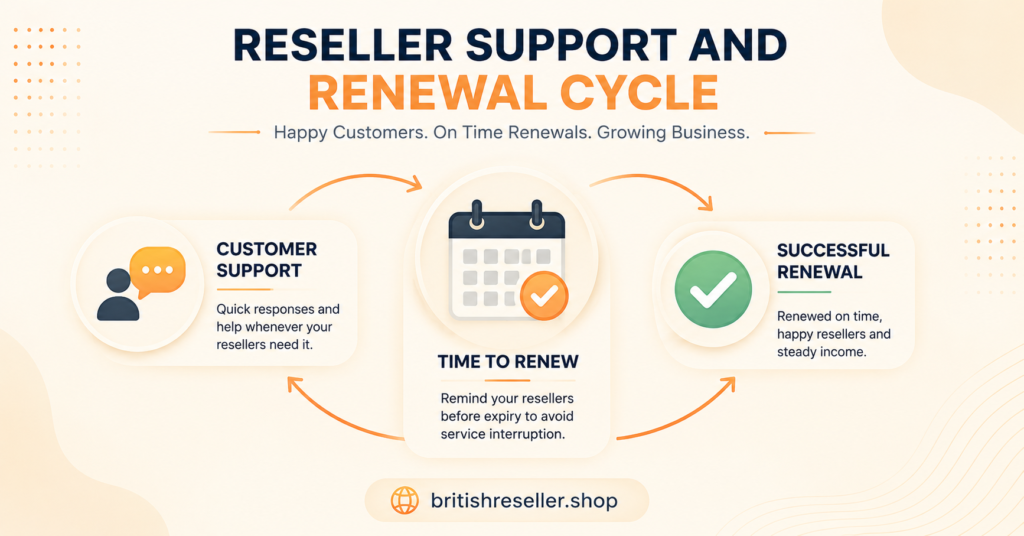
This is the figure that gets ignored the most, and it’s arguably the one that separates resellers who stick around from those who quietly disappear after six months. Every customer who doesn’t renew has to be replaced just to stand still, and finding a replacement customer usually costs more time and effort than keeping an existing one happy.
Below is a rough shape of how those factors tend to shift as a reseller’s customer base grows, without attaching invented numbers to it.
| Paying customers | What tends to change | What it usually asks of you |
|---|---|---|
| Under 20 | Side income, tested manually, easy to manage alone | A spare hour a week and a WhatsApp number |
| 20 to 75 | Renewals start overlapping, refunds and disputes appear | A simple record of who paid, what and when |
| 75 to 200 | Support load becomes the bottleneck, not sales | Faster response times, maybe a helper |
| 200 plus | Real churn management, possible sub-reseller layer | Proper tools, documentation, and delegation |
How IPTV Reseller Works explains the operational side of this in more detail, including how credits move from purchase to an active customer line.
Subscriber Numbers Versus Reseller Numbers
It’s worth separating two different questions people ask under this same keyword. Some are subscribers wondering what a reseller is charging and whether that price is reasonable. Others are considering becoming resellers themselves and want to know what’s realistically achievable.
For subscribers, the honest guidance is that price alone tells you very little about a service’s reliability. A cheap subscription that drops out during peak hours costs you more in frustration than a slightly pricier one that just works. Ask about device support, what happens if the service goes down, and whether there’s a clear refund policy before handing over money.
For prospective resellers, the more useful question isn’t “what’s the ceiling” but “what does a realistic first three months look like.” Most new resellers underestimate how long it takes to build a base of ten to twenty regular customers, and overestimate how quickly a few hundred pounds becomes a few thousand.
Pro tip: Before quoting yourself a monthly income target, track your actual renewal rate for two full billing cycles. That single figure will tell you more about your realistic earnings than any pricing calculator.
Common Pricing Mistakes That Quietly Cap Your Earnings
New resellers tend to make the same handful of errors, usually because nobody walks them through the difference between revenue and profit. The table below sets out the pattern most often seen, and a more sustainable way to approach each one.
| Mistake | Better approach |
|---|---|
| Pricing below every competitor to win customers fast | Price close to the market and compete on reply speed and reliability instead |
| Counting gross revenue as profit | Track credit cost against what customers actually pay, after refunds |
| Ignoring renewals until the customer has already gone quiet | Message customers a few days before their line runs out |
| Growing customer numbers faster than you can support them | Grow in line with how fast you can realistically answer messages |
Sub-Reseller Earnings: A Different Shape Entirely
If you’re operating as a sub-reseller rather than a direct reseller, your earnings picture has an extra layer. You’re typically buying credits from a parent reseller rather than directly from a provider, which often means a slightly thinner margin on each sale. Your income depends on three things instead of two: your retail price, your credit cost from your parent reseller, and how reliable that parent reseller is when something goes wrong with a customer’s line.
Sub-resellers who do well tend to treat that third factor seriously. A parent reseller who disappears for two days during an outage leaves you fielding angry messages with nothing useful to tell your customers, and that damages renewals just as much as a pricing mistake would.
What Support and Reliability Cost You If You Ignore Them
Earnings calculations rarely include the cost of a bad week, but it’s real. A customer who messages twice about buffering and gets no reply is a customer who cancels, tells two friends, and leaves a negative comment somewhere public. None of that shows up in a simple credits-times-margin sum, but it shows up in your renewal rate a month later.
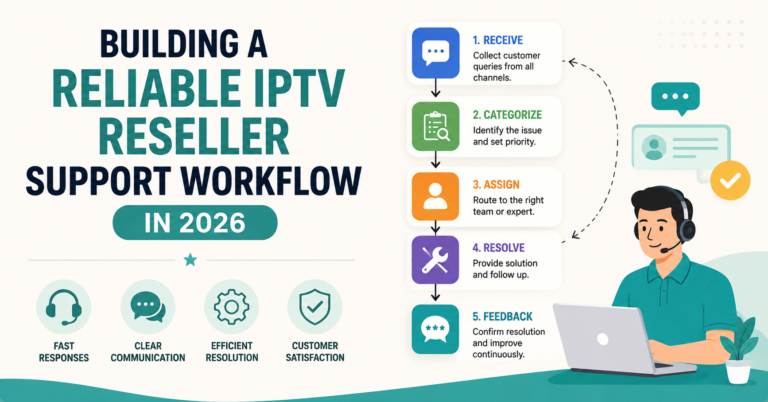
Resellers who treat support as part of the product, not an afterthought, generally see steadier numbers over time than those focused purely on acquiring new sign-ups. Reading connection logs when a customer reports a problem, rather than guessing, also saves time you’d otherwise spend going back and forth.
The blog covers more day to day operational topics like this if you want to go deeper on running the business rather than just pricing it.
Building a Realistic Monthly Target
Rather than chasing a number you’ve seen quoted online, it helps to build your own target from the ground up. Start with how many hours a week you can realistically spend on support and sales. Estimate how many customers that workload can comfortably serve without response times slipping. Multiply that customer count by your margin per sale, and you have a number grounded in your actual capacity rather than someone else’s marketing copy.
This approach also protects you from the most common trap in this business, which is growing customer numbers faster than your ability to look after them, and watching your renewal rate quietly collapse as a result.
Is IPTV Reselling Worth Doing for the Money Alone
If your only goal is fast, guaranteed income, this isn’t the business for that. Early months are usually slower than expected, and the first customers take real effort to find and keep. What makes it worthwhile for people who stick with it is that the margin structure rewards consistency. A steady base of renewing customers, even a modest one, tends to outperform a larger but unstable one chasing constant new sign-ups.
Anyone weighing this up should also factor in the legal side properly. Reselling access is only a legitimate business when the underlying content is properly licensed, and that responsibility sits with whoever is distributing it, not with the technology itself.
You can browse the homepage for a general sense of how a panel-based reseller setup is typically priced and structured, though your own numbers will depend entirely on your own pricing and customer base.
Visible FAQ
How much do IPTV resellers actually make in the UK?
There’s no fixed figure. Earnings depend on your customer count, your pricing, and crucially how many customers renew each month. A small side operation and a full-time reseller business can look completely different in income even with similar customer counts, if their renewal rates differ.
Is IPTV reselling profitable in 2026?
It can be, for resellers who treat it as a genuine small business rather than a quick side hustle. Profit comes from a healthy gap between wholesale credit cost and retail price, sustained by customers who keep renewing rather than a constant churn of new sign-ups.
Do I need a lot of customers to make good money?
Not necessarily. A smaller, well-supported customer base that renews reliably can outperform a larger one with poor retention, once you account for the extra time larger numbers demand.
What’s the biggest factor in reseller income?
Renewal rate tends to matter more than either pricing or customer count on their own. Losing customers faster than you replace them caps your income no matter how many new sign-ups you bring in.
Is IPTV reselling legal in the UK?
IPTV as a technology is legal. Whether a specific reselling business is legal depends entirely on whether the content being distributed is properly licensed, and that responsibility sits with the person or business doing the distributing.
Should I price low to attract customers faster?
Pricing far below the market often attracts customers who leave the moment a cheaper option appears elsewhere. Pricing closer to market rate and competing on reliability and response time tends to produce steadier long-term income.
Conclusion
How Much Can You Earn as an IPTV Reseller in UK (2026) ultimately depends on three things you control directly: your pricing, how many customers you can genuinely support, and how well you hold onto the ones you already have. There’s no honest single figure to quote, and anyone offering one is oversimplifying a business that runs on renewals more than sign-ups. The most reliable path is building your target from your own realistic capacity, pricing sensibly, and treating support as part of what you’re selling, not an extra. Start small, track your renewal rate closely, and let that number guide your growth rather than a figure you saw somewhere online.
Growth Checklist
- Work out your realistic support capacity before setting a customer target
- Price close to the market rate rather than undercutting everyone
- Track renewals separately from new sign-ups each month
- Reply to customer messages quickly, especially in the first month of a new subscription
- Keep a simple record of who’s due to renew and when
- Review your actual profit after refunds and disputes, not gross revenue
- Only take on a sub-reseller layer once your own customer base is stable