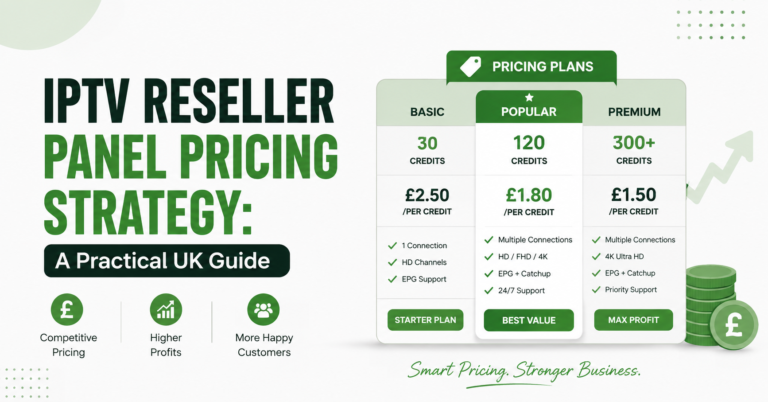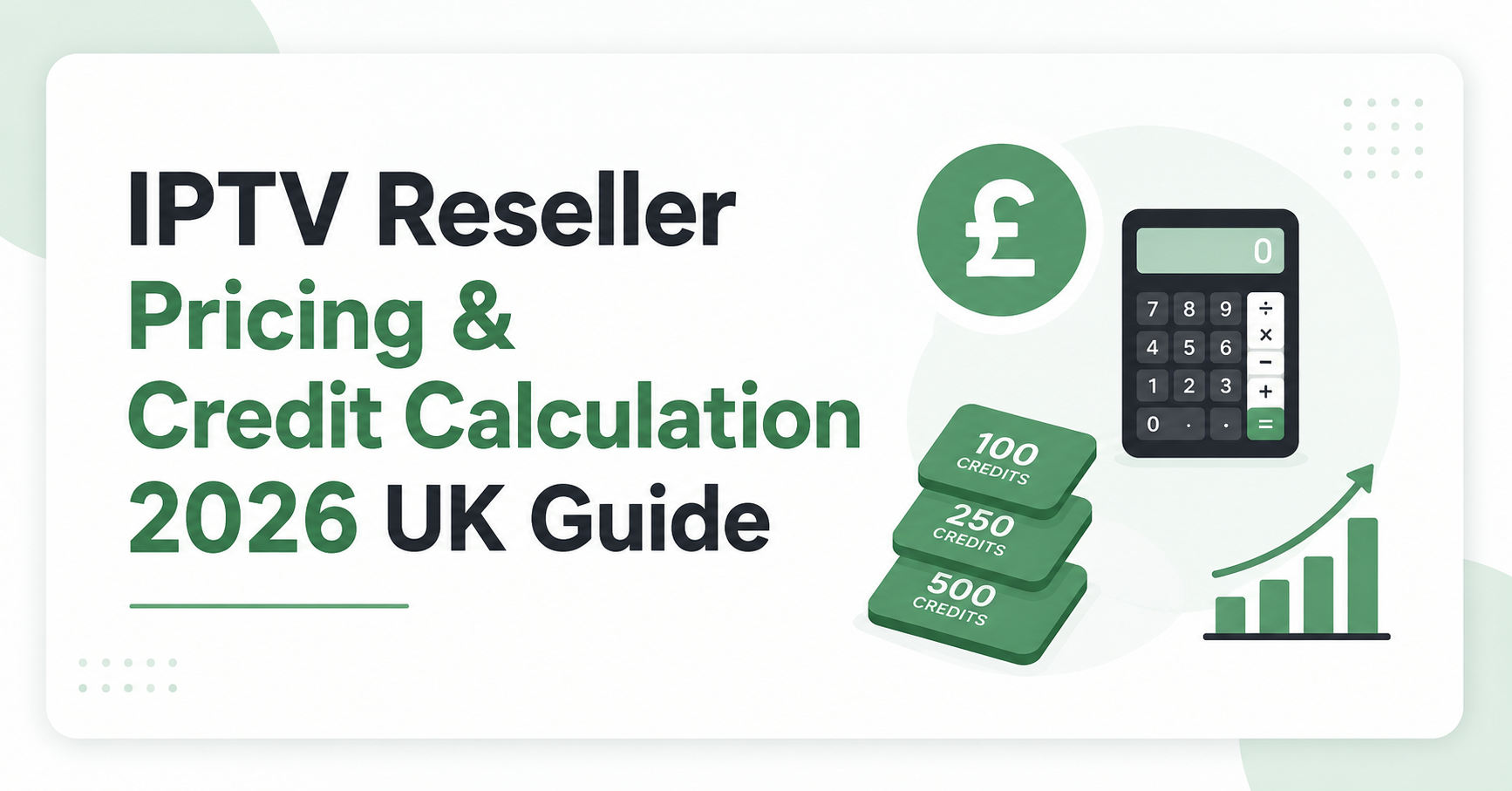

IPTV Reseller Pricing & Credit Calculation comes down to one simple relationship: you buy credits in bulk from a panel provider at a lower unit cost, then convert each credit into a customer subscription at a retail price you set yourself. The gap between what a credit costs you and what you charge a subscriber is your margin, and getting that gap right is what decides whether a reseller business is actually profitable once support time, refunds, and churn are factored in. This guide walks through how credit systems work, how to work out a price that protects your margin, and where UK resellers commonly get the sums wrong.
[ez-toc]
What Are IPTV Credits and How Do They Work
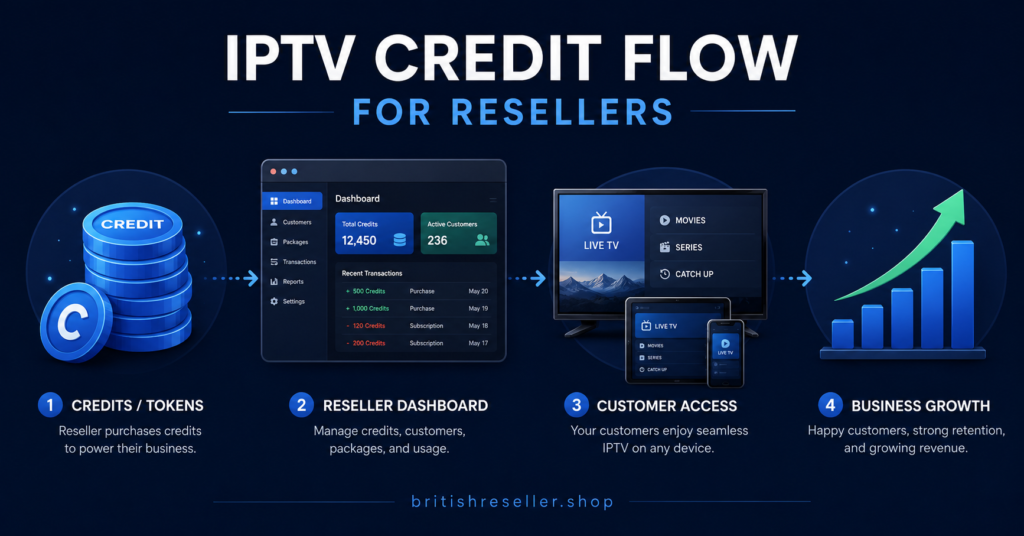
Most UK IPTV reseller panels, including illustrative examples like britishseller.co.uk, run on a credit system rather than a per-invoice billing model. You top up your reseller account with a batch of credits, and each time you activate or renew a customer line, a set number of credits is deducted depending on the subscription length. A one-month line might use one credit, while a twelve-month line typically uses considerably more, since you are pre-paying for a longer service commitment upfront.
Credits are attractive to providers because they simplify billing on their end and reduce administrative overhead. For resellers, they mean cash sits tied up in the panel until it is converted into active customers, so unused credits are essentially dormant stock. This is one reason topping up in smaller, more frequent batches can suit a reseller who is still building a steady customer base, rather than locking a large sum into credits that may take months to sell through.
Pro tip: Track your credit balance against your average monthly activations so you always know roughly how many weeks of stock you are holding, rather than topping up reactively when the balance hits zero.
Working Out Your Real Cost Per Credit
The advertised bulk price for a batch of credits is not always your true cost per customer. If a reseller buys 100 credits for a fixed price, the headline cost per credit looks straightforward, but that figure ignores a few things that quietly eat into margin: credits that expire unused, payment processing fees on your own sales, and the time spent on support tickets for each active line.
A more realistic way to calculate cost per customer is to divide your total spend on credits, plus any recurring panel or reseller dashboard fees, by the number of lines you actually activate in a given period rather than the number of credits purchased. This tends to produce a higher, more honest number than the headline credit price, and it is the figure that should actually drive your retail pricing decisions.
| Cost Factor | Why It Matters |
|---|---|
| Credit batch price | Sets your baseline unit cost |
| Unused or expired credits | Raises your true cost per active customer |
| Payment and refund handling | Reduces net revenue per sale |
IPTV Reseller Pricing & Credit Calculation for Different Subscription Lengths
Pricing rarely works as a flat multiple across every subscription length. Shorter plans, such as one or three months, usually carry a higher effective margin per month because they compensate for the extra churn risk and support overhead of customers who may not renew. Longer annual plans often carry a lower per-month margin but improve cash flow and reduce the repeated admin of monthly renewals.
A reasonable approach is to set your monthly-equivalent price for each length, then apply a modest discount as the term extends, similar to how mobile contracts reward longer commitments. This keeps pricing consistent for the customer while still reflecting that a twelve-month sale is more valuable to you upfront than twelve separate one-month sales, even before accounting for cancellation risk on shorter terms.
Pro tip: Avoid pricing your annual plan at exactly twelve times your monthly rate. A small discount, clearly presented, tends to convert better and still protects your margin once churn on monthly plans is accounted for.
Subscriber View: What Pricing Transparency Actually Looks Like
From a subscriber’s side, the credit system behind the scenes is irrelevant. What matters is whether pricing is presented clearly, whether the plan length and device limit are stated upfront, and whether refund terms are explained before payment rather than buried in a support ticket after a complaint. A subscriber comparing providers is really comparing clarity as much as price, since a slightly cheaper plan with vague terms is a worse deal than a clearer one that costs a little more.
Subscribers should also be able to see, before paying, how many devices or concurrent connections are included, since this affects whether the household actually needs one plan or two. A provider that only reveals this after purchase is creating a support problem for itself and an unfair surprise for the customer.
How Sub-Resellers Should Approach Credit Calculation
Sub-resellers sit a layer below the main reseller, buying credits or access at a rate set by their parent reseller rather than directly from the panel provider. This means their margin is already compressed before they set a single retail price, and the calculation needs an extra step: working out what the parent reseller’s rate leaves available after the sub-reseller’s own costs, such as their time, any marketing spend, and customer support.
A common mistake among newer sub-resellers is copying the parent reseller’s suggested retail price without checking whether it still leaves a workable margin at their own cost basis. Because sub-resellers are also more exposed if the parent reseller’s account is suspended or the panel changes terms, that dependency risk is worth factoring into pricing too, not just the raw credit cost.
Reseller View: Building a Pricing Model That Survives Refunds and Churn
A pricing model that only works when every customer stays for the full term and never asks for a refund is not a realistic model. Building in an assumed churn rate, even a conservative one based on your own activation and renewal history, gives a more honest picture of whether your pricing actually sustains the business month to month.
Refund policy matters here too. A generous refund window is good for customer trust, but if it is not reflected in your pricing or credit management, it can quietly erode margin on a portion of every batch you sell through. Reviewing your refund rate alongside your credit cost every few months is a simple habit that keeps pricing grounded in reality rather than assumption.
Common Mistakes in IPTV Reseller Pricing & Credit Calculation
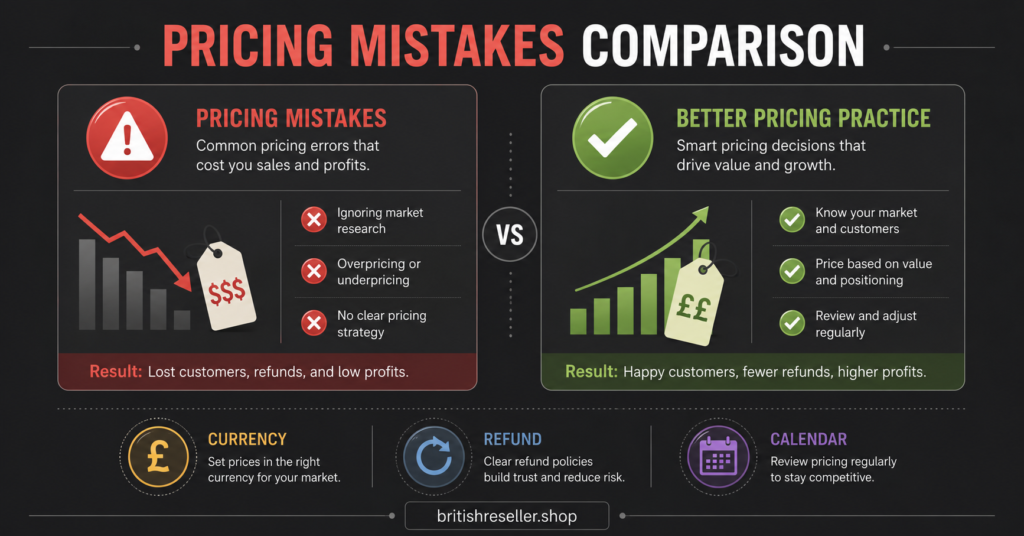
The most frequent mistake is pricing purely off the advertised credit rate without adjusting for expired credits, refunds, or support time. A second common error is undercutting competitors aggressively without checking whether the resulting margin still covers a realistic churn rate, which can leave a reseller technically busy but barely profitable.
A third mistake is ignoring currency and payment processing costs when the panel provider bills in a different currency to the one customers pay in. Small percentage losses on conversion and processing fees add up quickly across a large customer base, and they are easy to overlook until a monthly reconciliation shows the gap.
| Mistake | Better Approach |
|---|---|
| Pricing off headline credit cost only | Calculate true cost per active customer |
| Flat pricing across all term lengths | Adjust margin expectations by term |
| Ignoring processing and conversion fees | Reconcile actual net revenue monthly |
Questions Worth Asking a Panel Provider Before Buying Credits
Before committing to a large credit purchase, it is worth asking a provider directly how long unused credits remain valid, whether bulk pricing tiers exist for larger top-ups, and what happens to your credit balance if the UK IPTV reseller account is suspended or the provider changes its terms. These answers affect the real cost calculation far more than the headline price per credit.
It is also reasonable to ask how refunds and chargebacks are handled between the provider and the reseller, since this directly affects whether a reseller absorbs the cost of a subscriber dispute or shares it with the provider.
Legitimate Use and Content Rights
IPTV is a delivery technology, and legality depends entirely on whether the content being distributed is properly licensed and the distributor has permission to distribute it. Pricing and credit systems are simply the commercial mechanics behind that delivery, and a professional-looking dashboard or a working payment system says nothing about whether the underlying content rights are in order. Resellers and subscribers alike should check a provider’s transparency around business information, terms of service, and content rights before relying on pricing alone as a sign of legitimacy.
Frequently Asked Questions
How many credits does a typical customer subscription use?
This varies by provider and plan length. A one-month line generally uses fewer credits than a six or twelve-month line, since longer terms are prepaid in a single transaction.
Do unused IPTV credits expire?
Many providers set an expiry window on unused credits, so it is worth confirming this directly with your provider rather than assuming credits are valid indefinitely.
What is a reasonable margin for an IPTV reseller?
There is no universal figure, since margin depends on your cost per credit, support overhead, and churn rate. Working from your own real activation data gives a more accurate answer than following a generic percentage.
Should sub-resellers price the same as their parent reseller?
Not necessarily. A sub-reseller’s cost basis is set by the parent reseller’s rate, so pricing should reflect that starting point rather than copying a suggested retail price without checking the margin it actually leaves.
How does refund policy affect credit calculation?
A generous refund policy can reduce net revenue on a portion of sales, so it is worth factoring an assumed refund rate into pricing rather than treating every sale as final revenue.
Is a professional-looking reseller panel proof that a provider is legitimate?
No. A polished dashboard or working payment system reflects the software, not the licensing status of the content being distributed.