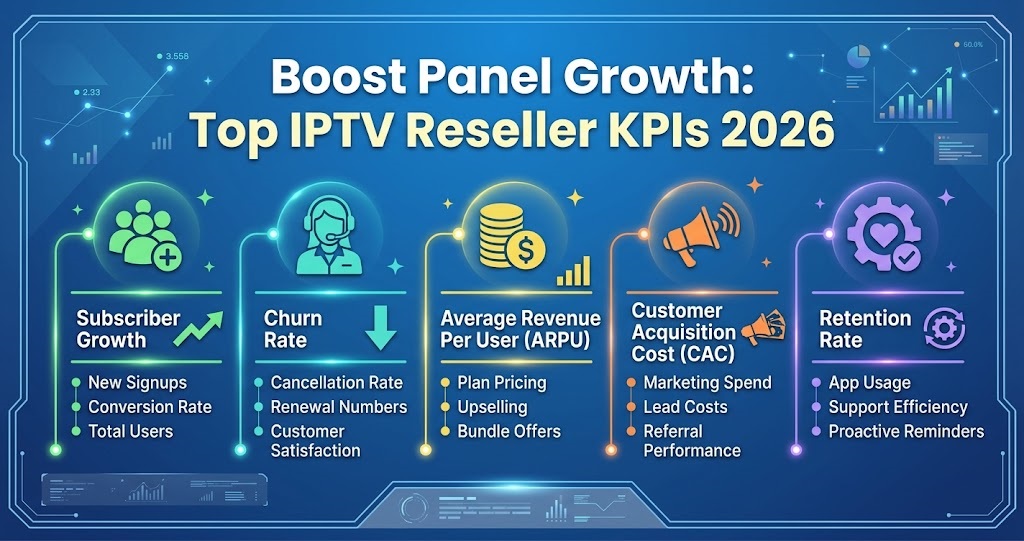

Most IPTV reseller KPIs fall into three groups: money, customers and operations, and tracking only one of them gives a misleading picture of how the business is actually doing.
A IPTV panel reseller who only watches revenue can easily miss a business that’s quietly losing money on refunds, or a support queue that’s about to cost them their best customers. KPIs exist to catch that kind of thing before it becomes a crisis rather than a footnote in next month’s accounts.
Which IPTV Reseller KPIs Actually Matter Each Month
Not every number a panel dashboard displays deserves attention every month. Some figures move slowly and only need a quarterly glance; others shift week to week and tell you something is going wrong right now.
The KPIs worth checking regularly usually sit in one of these categories:
- Credit cost and gross margin per customer line
- Credit utilisation rate across your account
- Customer renewal rate and churn
- Support ticket volume and response time
- Activation and trial-to-paid conversion
Treat these as a starting set rather than a fixed list. A reseller running mostly annual subscriptions cares about renewal timing in a different way to one selling short monthly plans, and the right mix depends on how your business is actually structured.
Working Out Gross Margin Per Customer
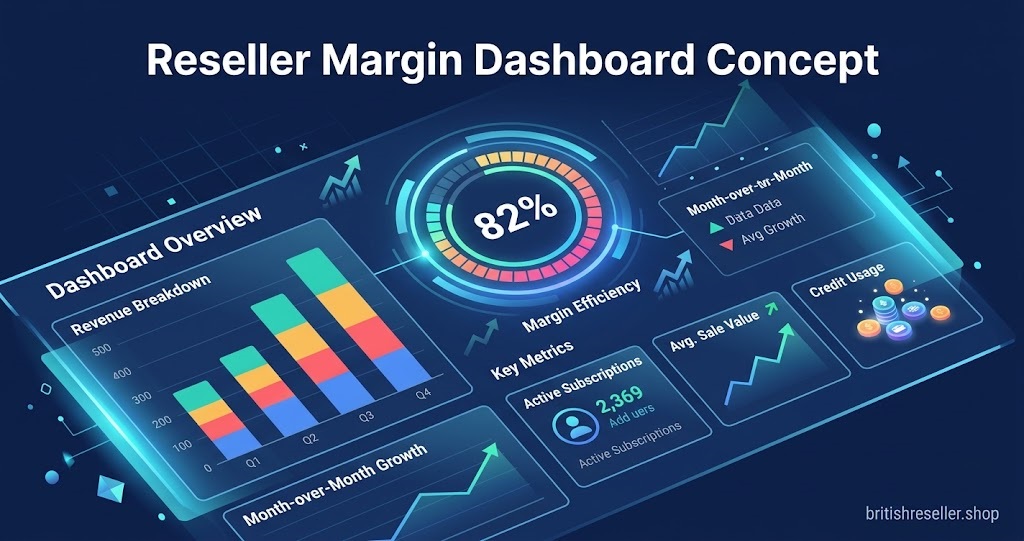
Gross margin is the simplest KPI to calculate and the one most resellers already track, even informally. It’s the difference between what a customer pays and what the credit cost you to create that line.
The formula itself is straightforward: retail price minus credit cost equals gross margin before expenses. What catches people out is stopping there and calling that number “profit.” Payment processing fees, refunds, chargebacks, support time and your own tax obligations all come out of that margin before anything counts as take-home income.
If you’re still working through the arithmetic on this, it’s worth spending time with a guide to reseller pricing and credit calculation before setting monthly targets, since getting the base formula wrong makes every KPI built on top of it wrong too.
Pro tip: Calculate gross margin per subscription length separately. A twelve-month customer and a one-month customer can look identical in total revenue while having very different margin profiles once renewal effort is factored in.
Credit Utilisation Rate: The KPI Resellers Forget
Credit utilisation measures how much of your purchased credit balance is actually being converted into active customer lines, rather than sitting unused. It’s calculated by dividing active credits in use by total credits purchased.
A low utilisation rate usually means one of two things. Either you bought a larger package than your current customer base needs, or you’re losing customers faster than you’re replacing them and the unused balance is quietly building up. Both situations tie up working capital that could otherwise fund marketing, support tools or a smaller, better-matched credit package.
Because credits are typically described as non-expiring rather than time-limited, it’s tempting to treat a large unused balance as harmless. It isn’t harmless from a cash-flow perspective, even if it isn’t actively wasted.
Customer Renewal Rate and Why It Outweighs New Sign-Ups
New customer acquisition gets most of the attention in reseller marketing discussions, but renewal rate is usually the KPI that decides whether a panel business is actually growing or just replacing lost customers with new ones.
Renewal rate is the percentage of customers due for renewal who actually renew, rather than lapsing or switching providers. A reseller who signs up twenty new customers a month but loses fifteen existing ones to non-renewal is barely treading water, even though the sign-up number looks healthy on its own.
| KPI | What it shows | How to calculate |
|---|---|---|
| Gross margin per line | Profitability before overheads | Retail price minus credit cost |
| Credit utilisation | How efficiently credits are deployed | Active credits ÷ total credits purchased |
| Renewal rate | Customer retention strength | Renewals ÷ customers due for renewal |
| Ticket volume per 100 customers | Support workload relative to size | Monthly tickets ÷ (total customers ÷ 100) |
Renewal rate also tells you something margin figures alone can’t: whether the service and support experience are good enough to keep people paying month after month. A supplier with excellent margins but poor renewal rates has a retention problem hiding behind healthy-looking revenue.
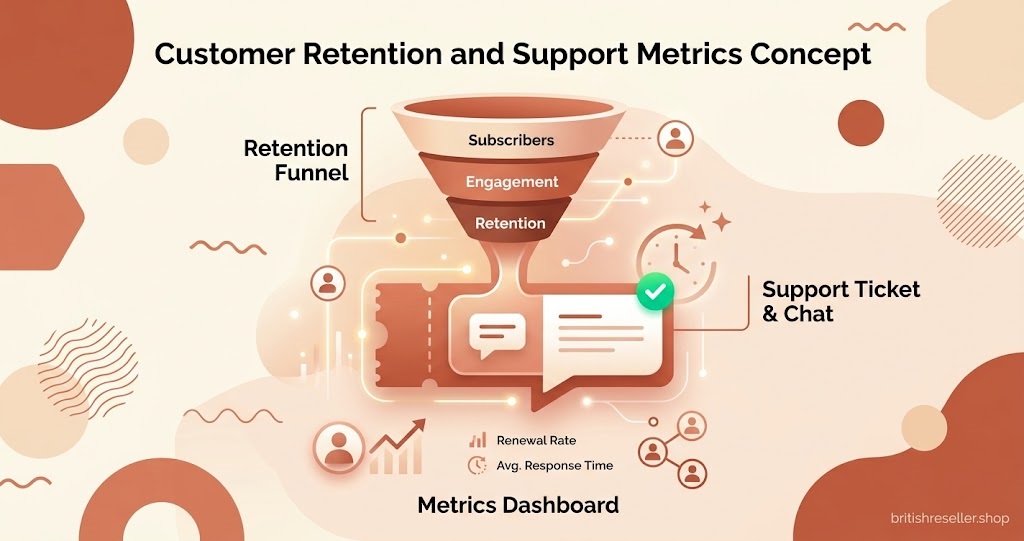
Support Load and Response Time
Support KPIs are easy to ignore until they become the reason customers leave. Two figures are worth watching: ticket volume relative to customer count, and average time to first response.
Ticket volume on its own means little without context. Fifty tickets from five hundred customers is a manageable one-in-ten rate; the same fifty tickets from eighty customers suggests something structural is wrong, whether that’s a device compatibility issue, an unclear setup guide, or a supplier-side reliability problem you’re absorbing as customer complaints.
Response time matters just as much as volume. A customer who can’t stream and doesn’t hear back for six hours is a customer who starts looking elsewhere, regardless of how good your credit pricing is. If support load is climbing faster than your customer base, it’s worth reviewing your IPTV Reseller panel comparison checklist to see whether the underlying panel tools are contributing to the workload.
Pro tip: Track first-response time separately from resolution time. A quick acknowledgement that you’re looking into an issue does more for customer confidence than a fast but silent fix.
Trial-to-Paid Conversion
If you offer a trial period, the conversion rate from trial to paid customer is one of the clearer signals of whether your marketing is attracting the right audience or simply generating volume.
A trial that converts poorly isn’t automatically a marketing failure. It can equally point to a mismatch between what was promised before the trial and what the customer actually experienced during it, particularly around device compatibility or content categories. Before assuming the marketing message is wrong, check whether the trial experience itself is representative of what paying customers get.
Sub-Reseller KPIs, When They Apply
If you allocate credits to sub-resellers rather than selling exclusively to end customers, a separate set of KPIs applies. Credit drawdown rate per sub-reseller, outstanding balances and support escalation frequency all matter here, because a sub-reseller’s customer problems eventually become your problem if they can’t resolve them independently.
The sub-reseller account setup guide covers the permission and credit-control side of this in more detail, which is worth reading before treating sub-reseller and direct-customer KPIs as interchangeable. They aren’t; a sub-reseller drawing down credits slowly might be struggling to sell, while one drawing down quickly with high support escalation might be underqualified for the responsibility.
Where Reseller KPI Tracking Usually Goes Wrong
The most common mistake isn’t tracking the wrong numbers, it’s tracking too many numbers without a consistent method for calculating them each month. If gross margin is calculated one way in January and a slightly different way in March, the trend line becomes meaningless.
The second common mistake is treating a single good month as a trend. Renewal rate especially can swing based on when annual subscriptions happen to fall due, so a three-month average tells you far more than any single month in isolation.
Pro tip: Keep a simple spreadsheet with the same four or five KPIs calculated the same way every month, rather than switching metrics whenever the current ones look unflattering.
IPTV Reseller KPI Tracking Checklist
- Calculate gross margin per subscription length, not just as a single average
- Check credit utilisation rate before deciding whether to buy more credits
- Track renewal rate as a three-month average, not a single snapshot
- Record support tickets per 100 customers alongside average response time
- Review trial-to-paid conversion whenever you change marketing messaging
- Separate sub-reseller KPIs from direct-customer KPIs if you allocate credits
- Use the same calculation method every month so figures stay comparable
Common Questions About IPTV Reseller KPIs
How often should I review my KPIs?
Monthly is usually enough for most panel-based reseller businesses. Weekly reviews make sense for support-related figures if you’re actively troubleshooting a specific problem, but calculating margin or renewal rate weekly tends to create noise rather than useful signal.
What’s a healthy renewal rate for an IPTV reseller?
There’s no universal benchmark, since it depends heavily on subscription length and pricing. What matters more is whether your own renewal rate is stable or declining over a rolling three-month period.
Should I track KPIs separately for each subscription length?
Yes, where practical. A one-month and a twelve-month customer can produce very different margin and support-cost profiles, and blending them into a single average can hide problems in one group.
Is credit utilisation more important than gross margin?
They measure different things and both matter. Gross margin tells you if pricing works; utilisation tells you if your credit balance matches your actual customer base.
Do I need software to track these KPIs?
No. A spreadsheet updated consistently each month is enough for most reseller operations. The value comes from calculating figures the same way every time, not from the tool used to record them.
Getting Started With IPTV Reseller KPIs
IPTV Reseller Panel KPIs only earn their place if they change what you actually do each month, whether that’s adjusting pricing, chasing renewals earlier, or reviewing why support tickets have climbed. Start small: track gross margin, credit utilisation and renewal rate consistently for three months before adding anything more detailed. Once those figures are stable, add support and conversion metrics to build a fuller picture of how the business is actually performing, rather than relying on revenue alone to tell the whole story.