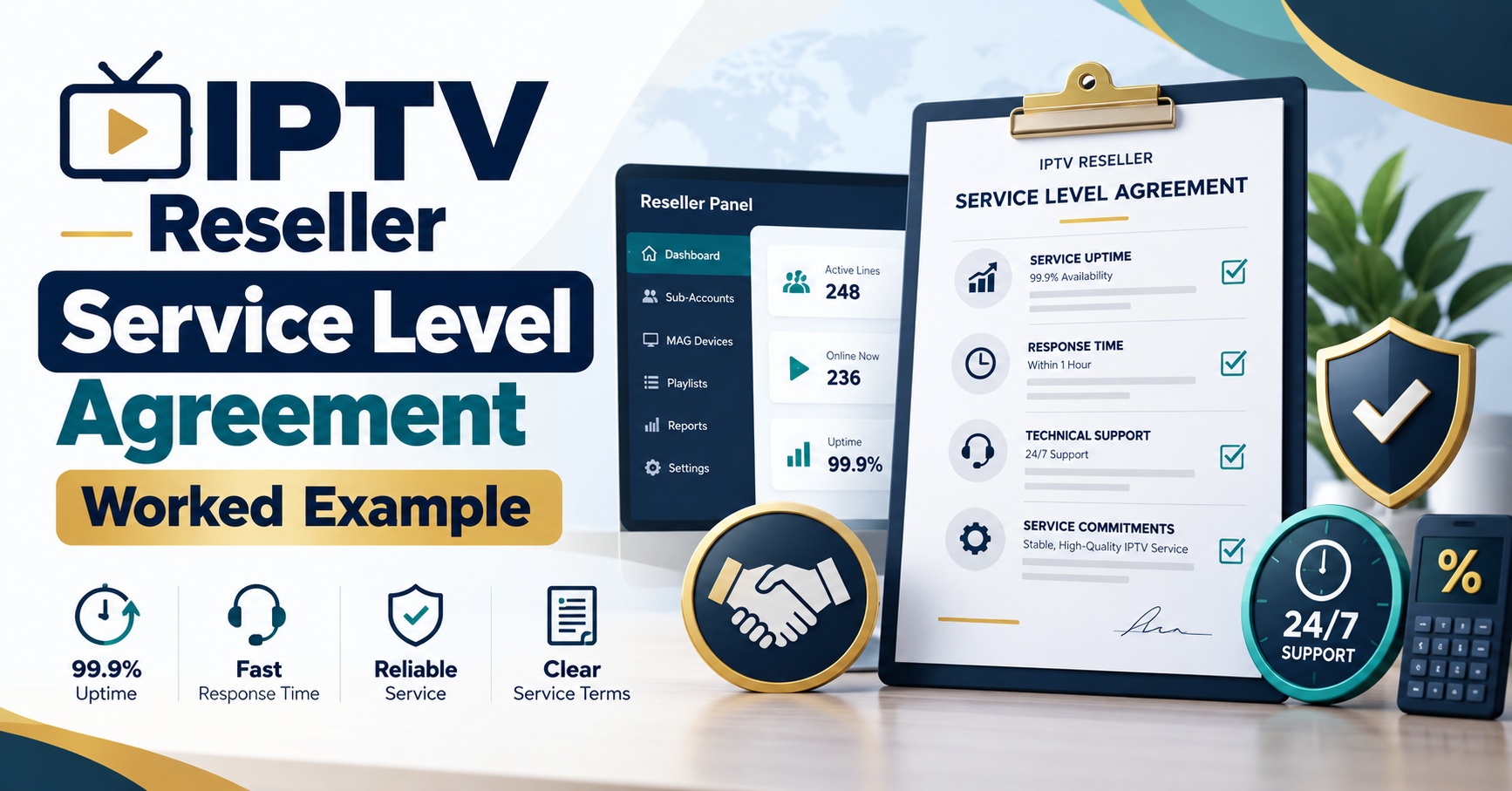

An IPTV Reseller Service Level Agreement is the written promise your upstream provider makes about how the service will perform: a measurable availability target, defined support response times, a clear list of exclusions, the remedy you receive when a target is missed, and a date when the terms are reviewed. If any of those five parts is missing, or is described only with words like “reliable” and “fast”, you do not really have an SLA. You have marketing copy with a contract heading.
There is a second agreement hiding behind the first. Whatever your supplier commits to becomes the ceiling for what you can honestly promise your own subscribers, so the terms you accept upstream quietly decide your refund policy, your support hours and the tone of every outage message you will ever send. Negotiating the supplier SLA is, in practice, deciding what kind of reseller you can afford to be.
Two Agreements, One Chain of Promises
Most UK IPTV panel resellers sit in the middle of a chain. The provider runs the servers and the panel, you manage credits and customers, and the subscriber only ever sees your name. When a stream fails at nine o’clock on a Saturday, the subscriber contacts you, not the provider.
That position creates a simple rule worth writing on the wall: never promise downstream what you have not secured upstream. If your supplier commits to responding to critical incidents within an hour, telling subscribers you will fix every problem within thirty minutes sets you up to break your word. If your supplier gives no response commitment at all, any promise you make is a personal guarantee funded by your own patience.
Sub-resellers sit one link further down and inherit the problem twice. Their parent reseller’s terms are limited by the provider’s terms, so a sub-reseller should ask to see what sits above them before agreeing to anything.
Turning “Reliable” Into Numbers You Can Check
Availability is the headline figure, usually written as a percentage. The percentage alone tells you very little until three other details are settled: the measurement period, what counts as “down”, and who does the measuring.
Converting percentages into minutes makes the difference concrete. Over a 30-day month (43,200 minutes), common targets allow the following downtime:
| Availability target | Downtime allowed per 30-day month |
|---|---|
| 99.0% | 432 minutes (7 hours 12 minutes) |
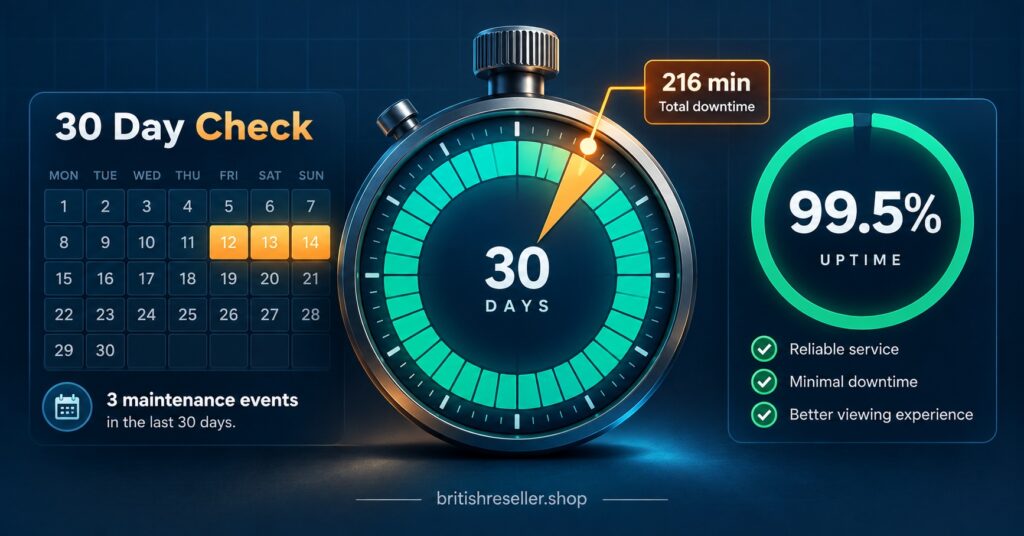
| 99.5% | 216 minutes (3 hours 36 minutes) |
| 99.9% | 43.2 minutes |
| 99.95% | 21.6 minutes |
A 99.5% promise sounds close to perfect, yet it permits more than three and a half hours of outage every month without any breach. That may be acceptable, but you should agree to it knowingly.
Next, the definition of “down”. A strong agreement names the services covered separately: the reseller panel, the stream delivery servers, the electronic programme guide feed and the authentication service that checks subscriber logins. A provider might keep the panel online while streams fail for half its users, and a loosely written SLA would record that as full availability. Ask whether partial outages count, and at what threshold (for example, a stated share of lines failing to load).
Finally, measurement. If only the provider’s internal monitoring decides whether an outage happened, you have no independent evidence. Running your own checks gives you timestamps you can put in front of the supplier, and the approach in this guide to IPTV reseller panel uptime monitoring is a practical starting point. Agree in writing that reseller-supplied monitoring logs will be considered when a breach is disputed.
Response Times and Resolution Times Are Different Promises
Suppliers often advertise “24/7 support”, which describes when someone might answer, not how quickly. An SLA should separate three clocks: time to first response, frequency of progress updates, and time to resolution or a workaround.
Resolution targets are hard for any provider to guarantee, because some faults depend on data centres, upstream networks or third-party software. Response and update commitments are fully within the provider’s control, which is why they matter most. A provider that acknowledges a critical fault within fifteen minutes and updates you every hour lets you keep subscribers informed, even when the fix takes longer.
Severity levels give those clocks structure. The targets below are illustrative examples of what a reseller might negotiate, not industry standards:
| Severity | Example in a reseller operation | Example targets to negotiate |
|---|---|---|
| Critical | Panel login fails, or most lines will not play | Response within 30 minutes, updates hourly |
| High | One server region failing, credit purchases not applying | Response within 2 hours, updates every 4 hours |
| Normal | Single line fault, EPG gaps on some channels | Response within 1 business day |
Two details are often missed. First, confirm which channel triggers the clock: a ticket system, an email address, or a messaging app. A complaint sent to the wrong place may never start the timer. Second, confirm the time zone and whether “business day” means the supplier’s working week or yours.
What an IPTV Reseller Service Level Agreement Should Exclude, and What It Must Not
Every SLA contains exclusions, and reasonable ones protect both parties. Scheduled maintenance is the classic example: it should be excluded only when announced with a minimum notice period (for instance 48 hours), limited in total length per month, and ideally kept outside peak evening hours.
Other fair exclusions cover problems the provider cannot control at the subscriber’s end: a home broadband fault, an unsupported device, an outdated player app, or local network filtering. That last one deserves care. Restrictions applied by internet service providers affect delivery, and the context in this article on ISP blocking of IPTV in the UK explains why such incidents are usually carved out of availability calculations.
Some exclusions are so broad they cancel the agreement. Be wary of wording that removes liability for “any upstream issue”, “events beyond our reasonable control” without a definition, or “emergency maintenance” with no cap on frequency or duration. A provider that can label any outage as emergency maintenance has promised nothing. Ask for a defined force majeure clause and a monthly ceiling on unannounced maintenance.
Watch for unilateral change rights as well. If the provider can amend the SLA at any time by updating a web page, insist on written notice before changes take effect and the right to leave without penalty if the new terms are worse.
Remedies: Service Credits, Their Limits, and a Worked Example
When a target is missed, the usual remedy is a service credit: a reduction applied to future purchases, calculated on a sliding scale. Credits are useful, but they are rarely compensation in any full sense, and the worked example below shows why.
All figures here are hypothetical and chosen only to illustrate the calculation.
A IPTV panel reseller spends £300 a month with a supplier. The SLA promises 99.5% monthly availability for stream delivery, with this credit schedule: 10% of that month’s spend if availability falls between 99.0% and 99.5%, and 25% if it falls below 99.0%.
During one month, the reseller’s own monitoring records 9 hours (540 minutes) of stream failure. A further 2 hours of maintenance was announced 48 hours in advance, so it is excluded.
Availability works out as (43,200 minus 540) divided by 43,200, which equals 98.75%. That is below 99.0%, so the reseller qualifies for a 25% credit: £75.
Now look at the other side of the ledger. Most of the outage landed on a single weekend evening. Suppose 40 subscribers contacted support, each conversation taking around six minutes: four hours of unplanned work. Suppose also that five subscribers paying £10 a month do not renew. The credit is a one-off £75. The lost renewals cost £50 every month they stay away.
The lesson is not that credits are worthless. It is that a monthly average can hide a concentrated failure, and the credit scale should reflect that. Three clauses help:
- A single-incident trigger, so any outage longer than a stated duration earns a credit regardless of the monthly average.
- A peak-hours weighting, where downtime during evening hours counts more heavily.
- A repeated-breach exit, allowing termination without penalty after a set number of missed months in a rolling period, with unused credits refunded or honoured.
Also confirm the form of the credit. Panel credits only have value if you keep buying from the same supplier, while a cash refund or invoice reduction keeps your options open. Check whether credits must be claimed within a deadline, because many agreements require a written claim within a fixed number of days, and an unclaimed credit is simply lost.

Where UK Law Sets a Floor Under the Contract
An SLA sits on top of statutory rules, and in the UK those rules work differently on each side of your business. This is general information, not legal advice; for a significant contract, a solicitor’s review is worth the cost.
Between you and your supplier, the relationship is business to business. In England, Wales and Northern Ireland, section 13 of the Supply of Goods and Services Act 1982 implies a term that a business supplying a service will carry it out with reasonable care and skill. Where a supplier contracts on its written standard terms, the Unfair Contract Terms Act 1977 means clauses limiting or excluding its liability for breach generally have to pass a reasonableness test. Courts look at factors such as relative bargaining power and whether the other side knew about the clause, so an aggressive exclusion buried in a long terms page is not automatically safe for the supplier.
Between you and your subscribers, consumer law applies and it is stricter. Under section 49 of the Consumer Rights Act 2015, a trader supplying a service to a consumer must perform it with reasonable care and skill, and section 57 prevents that liability from being excluded. In plain terms, even if your supplier’s SLA leaves you with very little, you cannot pass that gap on to your subscribers through your own small print. This is one more reason the upstream terms matter so much.
Readers outside the UK should check their own jurisdiction, as consumer protection and contract rules differ across English-speaking markets.
One more point that an SLA cannot settle: content rights. An uptime percentage, a polished panel and a signed agreement say nothing about whether the provider holds proper distribution rights for the programming it delivers. IPTV is a delivery technology, and legal use depends on licensing. Treat licensing as a separate question, and this guide on whether IPTV reselling is legal in the UK covers the distinctions.
Review Clauses Keep the Agreement Honest
An SLA that is signed once and never revisited drifts out of step with your business. Your subscriber count changes, the provider adds infrastructure or loses it, and targets that made sense at fifty lines may not suit five hundred.
Build in a review date, quarterly or every six months, and agree what evidence each side brings: your monitoring logs, the provider’s incident reports, ticket response records and a list of credits claimed and paid. A review backed by numbers is a negotiation; a review without them is a complaint.
The review clause should also cover communication during incidents. A provider that commits to publishing incident updates in a fixed place makes your job easier, and you can mirror that for subscribers by maintaining your own public page. This walkthrough on how to build an IPTV service status page shows one way to do it.
Lastly, plan the exit before you need it. The agreement should state how long you keep panel access after termination, whether you can export your customer and line data, and what happens to unused credits. Leaving a supplier mid-crisis without your data is far worse than the outage that prompted the move.
Questions That Expose a Weak Agreement Before You Sign
- Is availability defined separately for the panel, stream delivery and login authentication?
- Do partial outages count, and at what share of failing lines?
- Will my own monitoring logs be accepted as evidence in a dispute?
- Which contact channel starts the response clock, and in which time zone?
- Is unannounced or emergency maintenance capped each month?
- Is there a single-incident credit trigger, not only a monthly average?
- Are credits paid as cash or invoice reductions, or only as panel credits, and is there a claim deadline?
- Can the provider change the SLA without written notice?
- Can I leave without penalty after repeated breaches, and export my data when I do?
If a provider cannot answer most of these clearly, its wider credentials deserve a closer look too, and the process in this guide to IPTV reseller panel supplier verification is a sensible next step.
Frequently Asked Questions
Is a 99.9% uptime promise always better than 99.5%?
Only if both are measured the same way. A 99.9% target that excludes partial outages and unlimited emergency maintenance can deliver a worse experience than a 99.5% target with tight definitions. Compare the definitions before the percentages.
Can a provider change its SLA without telling me?
Some terms allow it, which is why you should negotiate a written notice period and the right to terminate if the revised terms are less favourable. Without that clause, check the provider’s published terms regularly and keep dated copies.
Should service credits be paid in cash or panel credits?
Cash or invoice reductions are more flexible because they do not tie you to the supplier. Panel credits are common and still useful, but their value disappears if you leave, so they make the exit clause even more important.
Do I need my own written service promise for subscribers?
It is good practice. A short, honest statement of your support hours, response times and outage communication sets expectations, and in the UK your subscribers already have statutory rights to services performed with reasonable care and skill, whatever your terms say.
Where to Start This Week
A useful IPTV Reseller Service Level Agreement comes down to five things you can test: a defined availability target with clear measurement, separate response and update clocks, fair and capped exclusions, credits that reflect concentrated failures, and a review and exit process backed by evidence. No agreement will stop outages from happening, and credits will rarely cover their full cost. What a well-written agreement does is turn vague assurances into commitments you can measure, claim against and, if necessary, walk away from.
The practical first step is to pull your current supplier’s terms, convert their availability figure into minutes per month, and run through the questions above. Whatever gaps you find are the points to raise at your next review, before the next busy evening tests them for you.