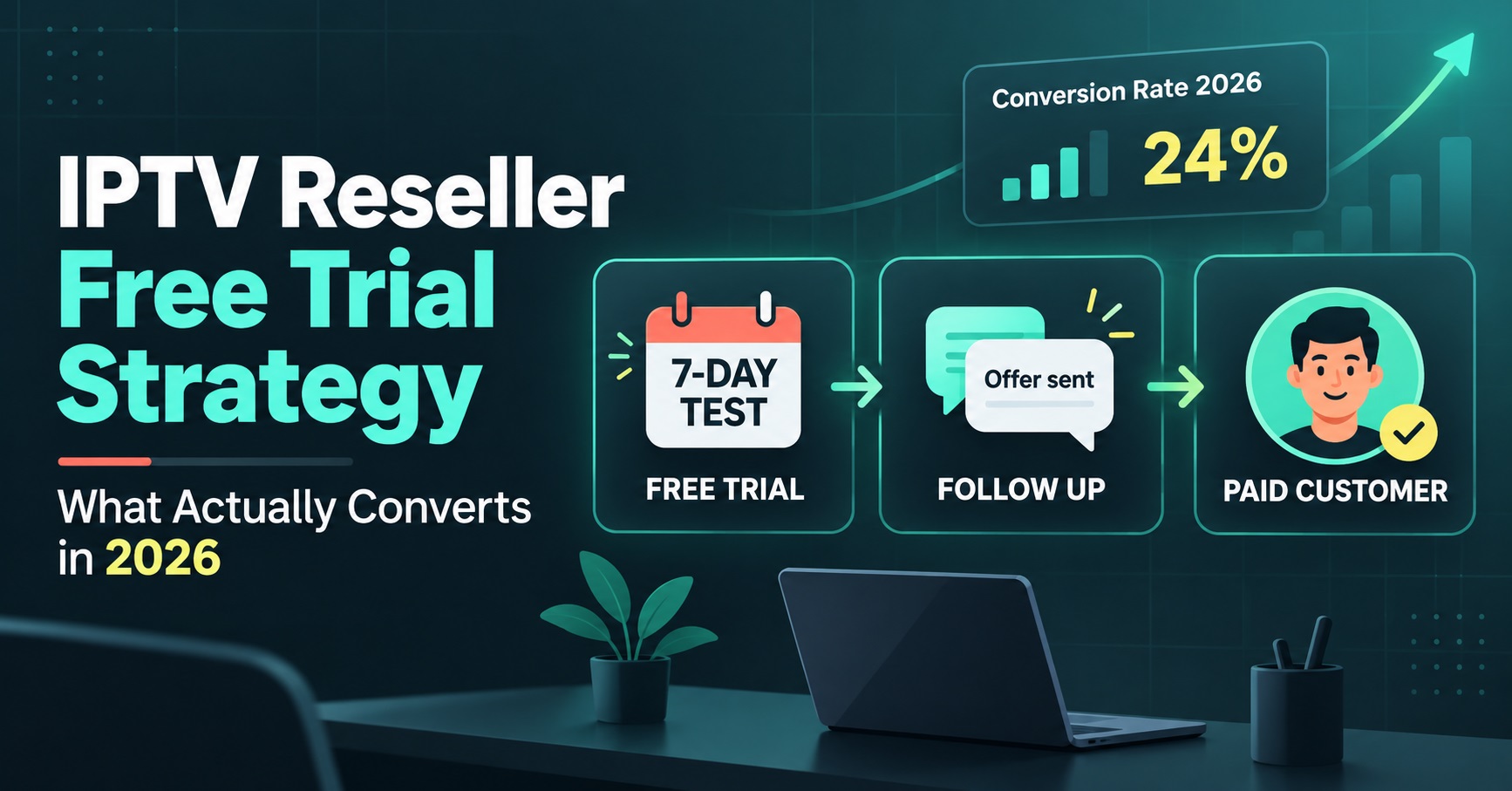

An IPTV reseller free trial strategy is the plan a reseller uses to decide how long a trial lasts, what it includes, and how a tester gets converted into a paying customer. Get any one of those three wrong and the trial becomes a cost centre instead of a sales tool. Most IPTV panel resellers treat the trial as a formality tacked onto the sign-up page, when it should really be treated as the first stage of the customer relationship.
What a Trial Is Actually Testing
A trial exists to answer one question for the customer: will this work reliably on my device, on my connection, at the times I actually watch? It is not there to prove the catalogue is large or the interface looks polished. Those things matter later, but during the trial window the customer is really checking for buffering, dropped connections during peak hours, and whether the app they were given actually works on their television or box.
That means the trial period needs to include at least one evening peak slot, ideally a weekend, so the customer sees real-world performance rather than a quiet Tuesday afternoon. A 24-hour trial that runs from Monday morning to Tuesday morning misses Friday and Saturday night entirely, which is exactly when most complaints about buffering happen.

Deciding Trial Length
Most reseller panels default to a short window, often somewhere between one hour and 24 hours. Shorter trials reduce the cost of abuse but also reduce the chance a customer sees the service at a genuinely busy time. Longer trials convert better in general, but they also attract people who never intended to pay and simply want free access for a weekend.
There is no single correct answer here, but the decision should be based on what you are trying to filter for.
| Trial length | Best suited to | Main risk |
|---|---|---|
| 1 to 2 hours | Quick device compatibility checks | Misses peak-time performance entirely |
| 24 hours | General testing including one evening | Can still miss a weekend if timed badly |
| 48 to 72 hours | Customers switching from another provider | Higher abuse rate, more support load |
Pro tip: If you only offer a short trial, tell the customer exactly when to test it. A message saying “please try this between 7pm and 10pm tonight” does more for conversion than doubling the trial length.
Limiting What the Trial Includes
A trial does not need to mirror every feature of a full paid line. Restricting the number of simultaneous connections during the trial, or capping which device profiles can be activated, reduces the chance the same trial gets shared between several people who were never going to buy anything.
It also helps to keep trial accounts visually separate in the panel from paying customers. When trial and paid lines sit in the same list with no clear label, it becomes easy to lose track of who has actually converted and who is still on a free line well past the point they should have been removed.
Following Up Before the Trial Ends
The single biggest mistake in most IPTV panel reseller trial strategies is silence. A customer signs up, gets credentials, and hears nothing else until the trial simply stops working. At that point they have no reason to come back rather than trying a competitor’s trial instead.
A short message part-way through the trial, and another shortly before it expires, gives the customer a natural point to ask questions or raise a problem before they’ve mentally moved on. This is not about being pushy. It is about being the reseller who was actually present when the customer needed a quick answer about app setup or a login issue.
Pro tip: Send the follow-up message with a specific next step, such as “reply here if you’d like to continue on the monthly plan,” rather than a generic “how did you find the trial?” that invites no action.
Where Trials Cost More Than They’re Worth
Every trial consumes staff time, whether that’s answering setup questions, resetting credentials, or troubleshooting a device that isn’t compatible. If a large share of trial requests come from people asking for repeated free extensions, or from accounts that request a trial, disappear, then request another trial from a different contact detail, that time is being spent on people who were never going to convert.
Tracking a simple conversion rate, even a rough one kept in a spreadsheet, tells you whether the current trial length and rules are actually working. If conversion sits well below what similar resellers report, the problem is usually the trial length, the follow-up message, or the lack of a clear next step at expiry rather than the underlying service itself.

Sub-Reseller Trial Rules Need to Match Yours
If sub-resellers are issuing trials from credits you’ve allocated to them, their trial practices reflect on your service even though you have no direct contact with the end customer. A sub-reseller who hands out unlimited-length trials to anyone who asks is spending your credit allocation on customers who were never screened for genuine interest.
Setting a written trial policy for sub-resellers, covering maximum length, maximum trials per customer, and what information must be collected before a trial is issued, keeps the whole operation consistent rather than leaving it to whatever each sub-reseller decides on their own.
For a fuller breakdown of allocating credits and setting permissions, the guide on setting up sub-reseller accounts and managing credits covers the account structure this depends on.
Building the Rest of the Acquisition Plan Around the Trial
A trial only works as part of a wider plan for getting customers to the sign-up point in the first place. Referral incentives, clear pricing on the landing page, and honest descriptions of what the service does and doesn’t include all affect who actually requests a trial. Resellers advertising unrealistic claims tend to attract trial users who cancel the moment reality doesn’t match the promise, which inflates trial volume without improving conversion.
The broader approach to reaching those customers is covered in the IPTV marketing strategy guide for 2026, and the practical side of turning enquiries into customers is covered separately in the guide on getting customers for an IPTV panel reseller business.
Before any of this, it’s worth checking your obligations. IPTV is a delivery technology rather than proof of licensing, and the way trials are marketed should not misrepresent content rights. The UK legality guide sets out where the responsibility sits.
Once the trial converts, the actual margin on that customer depends on your credit cost against your retail price, which is broken down in the pricing and credit calculation guide.
Common Questions
How long should an IPTV reseller trial last?
There’s no fixed correct length. A window that covers at least one evening peak period, whether that’s 24 hours or slightly longer, generally gives a more honest test than a very short daytime-only trial.
Should trial customers get full access to every feature?
Not necessarily. Limiting simultaneous connections or certain device profiles during the trial reduces sharing and abuse without stopping a genuine customer from properly testing the service.
What’s the biggest reason trials fail to convert?
Lack of follow-up. Most resellers issue the trial and then go quiet until it expires, leaving the customer with no reason to come back rather than testing a competitor’s offer instead.
Should sub-resellers set their own trial rules?
Ideally no. A shared trial policy covering maximum length and number of trials per customer keeps quality consistent across everyone issuing trials from your allocated credits.
Is it worth tracking trial conversion rates?
Yes. Even a rough spreadsheet showing how many trials turn into paying customers tells you quickly whether your current trial length and follow-up approach are actually working.
Getting the Trial Strategy Right
An IPTV reseller panel free trial strategy comes down to three decisions: how long the trial runs, what it restricts, and what happens before it expires. None of those decisions need to be complicated, but skipping any one of them tends to show up later as a low conversion rate that’s hard to trace back to its cause. Start by fixing the trial window so it genuinely covers peak usage, add a short follow-up message before expiry, and keep a basic record of how many trials actually convert. From there, the rest of the acquisition plan has something solid to build on.
Trial Strategy Checklist
- Trial window includes at least one evening peak period
- Trial accounts are visually separated from paying customer lines in the panel
- A follow-up message is sent before the trial expires, with a clear next step
- Simultaneous connections or device profiles are limited during the trial
- Sub-resellers follow a written trial policy matching your own rules
- Conversion rate is tracked, even informally, to spot problems early
- Marketing claims match what the trial customer will actually experience