
An IPTV reseller panel is a web-based dashboard that lets you create, manage and renew customer subscriptions yourself, using pre-bought credits, instead of relying on a provider to set each customer up manually. You log in, spend a credit, and generate a working line with a username, password and M3U link in under a minute. That’s the entire mechanism. Everything else, credits, bouquets, sub-resellers, support tools, exists to make that one action faster, more controllable and easier to scale.
[ez-toc]
This Guide How IPTV Reseller Panels Work clear your all doubts about IPTV reseller panel ecosystem.
What an IPTV Reseller Panel Actually Is
Strip away the marketing language and a reseller panel is just account management software. It sits between you and a larger IPTV infrastructure, and it gives you a controlled window into that infrastructure rather than full access to it.
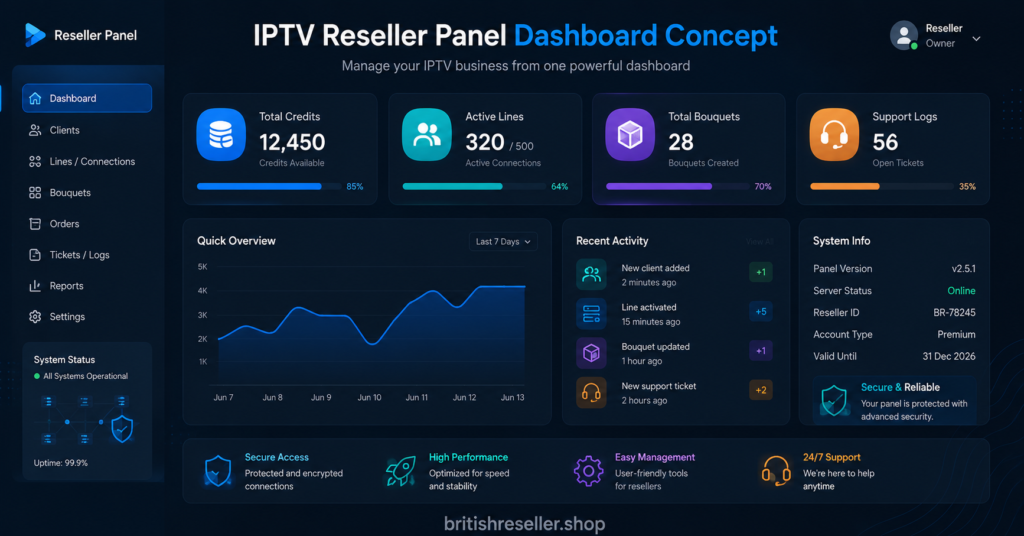
You don’t touch servers. You don’t configure streams. You log into a browser dashboard, and from there you can create a customer, extend a customer, kill a customer’s access, or hand a slice of your own account to someone else as a sub-reseller. The panel is the entire interface for running an IPTV reseller UK business day to day.
For anyone coming from a completely different industry, the closest comparison is a hosting reseller account. You don’t own the data centre. You buy a block of resources, and a dashboard lets you carve that block up into individual customer accounts, each with its own login and its own limits.
Pro tip: Before committing to any panel, ask to see the actual dashboard, not a screenshot. A five-minute screen share tells you more about how usable it is than any features list.
Why Panels Replaced Manual Provisioning
Before dashboards like this became standard, setting a customer up meant messaging a provider directly and waiting for them to create the account by hand. That worked when volumes were tiny. It fell apart the moment anyone tried to run this as an actual business.
A panel removes the provider from that loop entirely. You place the order, the panel processes it, and the customer has working credentials while you’re still on the same phone call. This is the operational shift that made IPTV reselling viable as a side income or a full business rather than a hobby.
The Core Mechanic: Credits
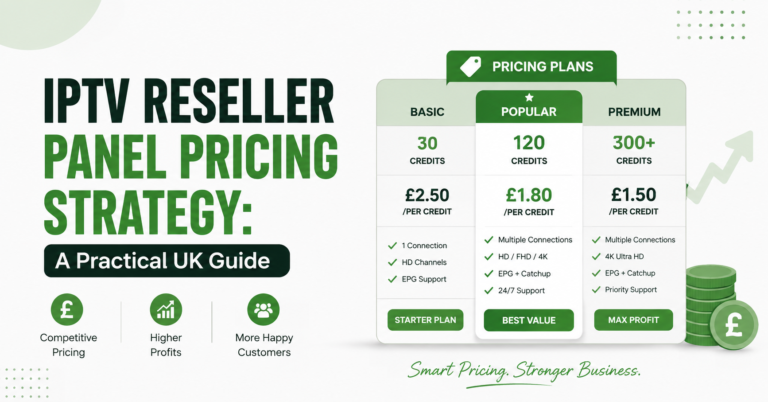
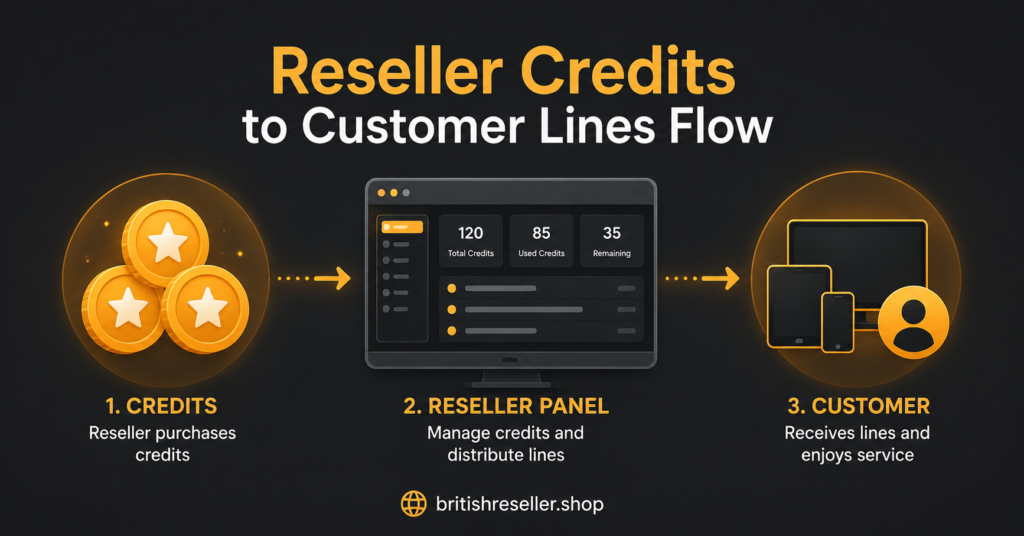
Credits are the currency inside the panel, and understanding them properly avoids most of the confusion new resellers run into. A credit is typically consumed when you create or renew one month of service for one customer. Buy a block of credits upfront, and the panel deducts them automatically as you use them.
The two details worth checking before you buy from any provider are whether credits expire and whether unused credits carry over. Some panels quietly expire credits after a fixed window, which effectively forces you to keep topping up even during a slow month. Others let credits sit indefinitely until you use them. That difference has a real effect on cash flow, especially in your first few months while you’re still building a customer base.
| Question to ask | Why it matters |
|---|---|
| Do credits expire? | Expiring credits punish slow months and force unnecessary top-ups |
| Is there a minimum order size? | Affects how much capital you need before you can start |
| Can credits fund different durations? | Some panels let one credit cover a month, others require separate SKUs for 3, 6 or 12-month lines |
Creating a Customer Line, Step by Step
This is the part every new IPTV Panel reseller wants to see spelled out plainly, because it’s the daily task you’ll repeat more than any other.
A customer contacts you, usually through WhatsApp, a website, or word of mouth, and agrees to a price. You log into the panel, select the package length, choose which channel bouquet they’re getting, and hit generate. The system deducts the relevant credits and returns a set of login details, normally both an M3U link and an Xtream Codes-style username and password combination, since different apps expect different formats.
You send those details to the customer, they enter them into their player of choice, and the service starts working. There’s no manual configuration on your end and nothing for the customer to install beyond an app they likely already have.
Managing Existing Customers
Creating lines is only half the job. What separates a functioning reseller business from a chaotic one is what happens after that first sale.
Renewals. A customer’s month runs out and they want another one. You extend the existing line rather than creating a new account, which keeps their setup unchanged and avoids confusing them with new login details.
Non-payment or disputes. If someone stops paying or a payment is disputed, the panel lets you disable or delete the line immediately. This is a basic but essential control, and its absence from a panel should be treated as a red flag.
Credential changes. If a customer shares their login more widely than intended, or simply forgets their password, you can reset the username or password from the same dashboard without touching anything else on their account.
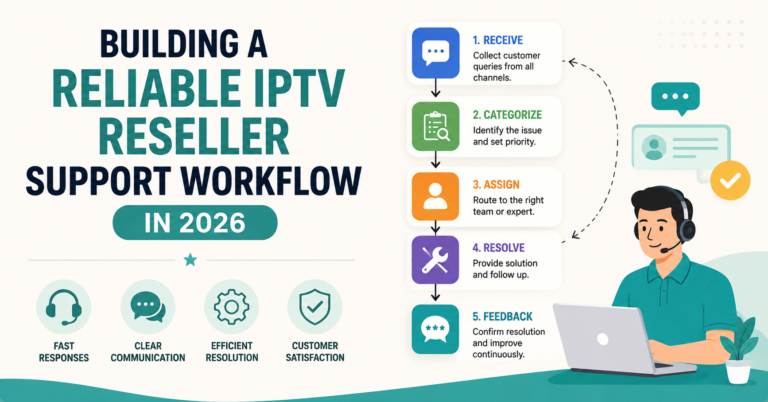
Diagnosing complaints. When a customer says the stream is buffering, a decent panel gives you connection logs so you can see whether the problem sits with the server side or the customer’s own connection, rather than guessing.
Bouquets and Package Control
Not every customer wants, or should pay for, the same package. Bouquets let you group channels into tiers, so you might offer a cheaper entry-level package alongside a fuller one, and price each accordingly.
This matters more for the reseller side of the business than the technical side. It’s the mechanism that lets you build a pricing structure instead of selling one flat product to everyone, which in turn is what makes upselling and tiered retention possible.
Sub-Reseller Accounts: Going a Level Deeper
Once a reseller has steady volume, many panels allow them to create sub-reseller accounts, effectively handing someone else their own scaled-down panel underneath the main account.
For resellers, this is a way to grow without doing all the customer-facing work yourself. A sub-reseller buys credits from you at a markup, sells to their own customers, and you earn the difference without managing those end customers directly.
For sub-resellers, the trade-off runs the other way. Margins are usually smaller than dealing directly with the top-level provider, and the whole arrangement depends on the parent reseller staying reliable, responsive and in business. Customer ownership and support responsibility in this arrangement should be agreed clearly upfront, not assumed.
| Setup | Who manages customers | Who sets retail price |
|---|---|---|
| Direct reseller | You, directly | You |
| Sub-reseller | You, under a parent panel | You, within margin limits set above you |
Free Trials as a Sales Tool
Most panels allow a capped number of free trials, often somewhere around 24 to 72 hours of access with no payment required. This exists because IPTV is a service people are naturally cautious about buying blind, and letting a prospect test channels, picture quality and reliability before paying removes a lot of that hesitation.
Pro tip: Give trials during genuine peak viewing hours, not at 3am when almost any service looks fast. A trial that only ever gets tested during quiet periods sets an expectation you may not be able to meet later.
Devices and Compatibility
A well-built panel doesn’t limit you to one type of customer device. Lines created through the dashboard typically work across Android and iOS phones, Android TV boxes, Amazon Fire TV devices, Smart TV apps, MAG boxes and Enigma2 receivers, because the underlying login formats, M3U links and Xtream Codes credentials, are widely supported standards rather than something proprietary to one app.
This is worth checking directly rather than assuming. If a customer asks whether their specific device works and you can’t answer confidently, that’s a sign to test it yourself before promising anything.
What Subscribers Should Understand
If you’re evaluating an IPTV service as a subscriber rather than a reseller, the panel itself is invisible to you, but its quality still affects your experience. A well-run panel means your provider can fix problems, issue refunds or change your credentials quickly. A poorly run one means slow responses and no real visibility into what’s happening on the backend when something breaks.
Ask any provider directly about device limits, refund terms and how support actually gets handled when a channel drops. Vague answers to specific questions are usually more informative than the answers themselves.
Reseller Panel UK Considerations
Running an IPTV reseller panel UK business specifically brings a few practical points worth flagging. Support availability that matches UK evening and weekend usage patterns matters more than most new resellers expect, since that’s when the bulk of complaints tend to land. Clear terms around credit refunds, and transparency about who you’re actually buying from, both affect how sustainable the business is beyond the first few months.
Legality and Where Responsibility Sits
IPTV as a technology is simply television delivered over the internet rather than through an aerial or satellite dish, and that alone is not something anyone needs to worry about. Whether a specific IPTV service is operating legitimately depends entirely on whether the content being streamed is properly licensed, not on how professional the website or panel looks. A polished dashboard and a working payment system are not evidence of licensing status.
Responsibility for what content is being distributed sits with whoever is doing the distributing. Anyone entering this space, whether as a subscriber or a reseller, should treat provider transparency, clear terms, and straightforward answers about licensing as basic due diligence rather than optional extras. This article covers panel mechanics only, and nothing here should be read as legal advice; if you’re unsure where you stand, that’s a conversation for a solicitor familiar with your jurisdiction.
For a working example of how a UK-facing reseller panel presents its own credit structure and account tools, Smark’s reseller panel page lays out the mechanics discussed above in more detail, and britishseller.co.uk is another provider that operates along broadly the same lines. Neither should be taken as a recommendation, and the same questions about licensing and transparency apply to both.
Common Beginner Mistakes
| Mistake | Better approach |
|---|---|
| Buying the maximum credit bundle immediately | Start smaller and reorder once you have real demand |
| Never testing the service yourself first | Run it on your own devices for at least a week before selling |
| Ignoring connection logs when troubleshooting | Use them to separate server issues from customer-side issues |
| Setting prices without checking the market | Look at what comparable UK resellers charge before settling on a number |
Frequently Asked Questions
Do I need technical skills to use an IPTV reseller panel?
No specialist skills are required to operate the dashboard itself. Creating and managing lines is a point-and-click process. Some basic comfort with troubleshooting connection issues helps once you have real customers.
How long does it take to set up a customer after they pay?
Once you’re logged into the panel, generating a line typically takes under a minute. The main delay in practice is usually on the payment or communication side, not the panel itself.
Can I run both subscriber-facing sales and sub-reseller accounts from one panel?
Many panels allow this, letting you sell directly to end customers while also supplying sub-resellers, though the exact structure depends on the specific provider’s account types.
What happens if I run out of credits?
You simply can’t create or extend lines until you buy more. Existing customer lines already created generally keep working until their paid period runs out.
Is an IPTV reseller panel the same as owning IPTV servers?
No. The panel is a management interface. The underlying servers, content sourcing and infrastructure are handled by whoever supplies the panel to you.
Can I change what a customer is paying for after I’ve created their line?
You can usually change their bouquet or extend their duration, but this depends on the specific panel’s feature set, so it’s worth confirming before you rely on it.
Conclusion
At its core, an IPTV reseller panel works by turning a block of pre-bought credits into individually manageable customer lines, giving you full control over creating, renewing, disabling and pricing those lines without depending on manual provisioning from a provider. Sub-reseller structures, bouquets and free trials all sit on top of that basic mechanic rather than replacing it. The details worth checking before choosing a panel, credit expiry, support responsiveness, refund terms and transparency around licensing, matter more than any headline channel count. If you’re still deciding whether to start, the sensible next step is testing a service on your own devices before you offer it to anyone else.
Setup Checklist
- Confirm whether credits expire and whether they roll over
- Test the panel’s line creation process yourself before offering it to customers
- Check device compatibility for the platforms your target customers actually use
- Ask directly about refund terms and support response times
- Understand the licensing basis of the content before distributing anything
- Set your pricing after checking what comparable UK resellers charge