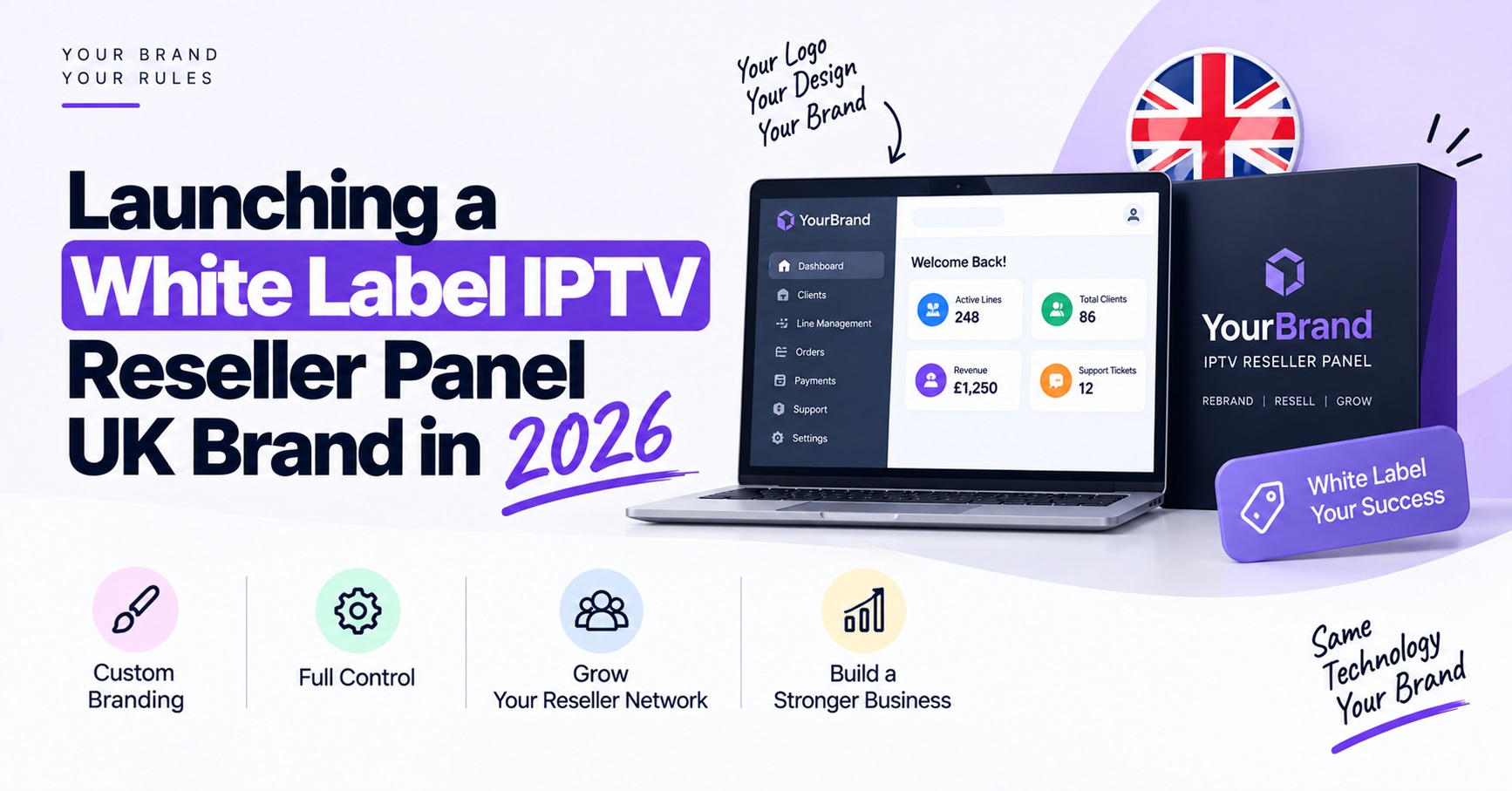

A White Label IPTV Reseller Panel UK setup lets you sell subscriptions under your own business name, with your logo on the app, your domain on the customer portal and your prices on the invoice, while the provider runs the servers and delivery infrastructure behind it. You manage customers through a reseller dashboard, buy access in credits, and your subscribers deal with your brand rather than the company upstream.
The catch is that “white label” means very different things depending on who is selling it. Some providers only let you swap a logo inside a generic player app. Others hand over a fully branded app, your own portal address and a client area you control. Before you compare prices, find out exactly which parts carry your brand, who holds the customer records, and what happens to your subscribers if the upstream service changes terms or disappears. Those answers will shape your business far more than anything on a feature list.
What Actually Carries Your Brand, and What Doesn’t
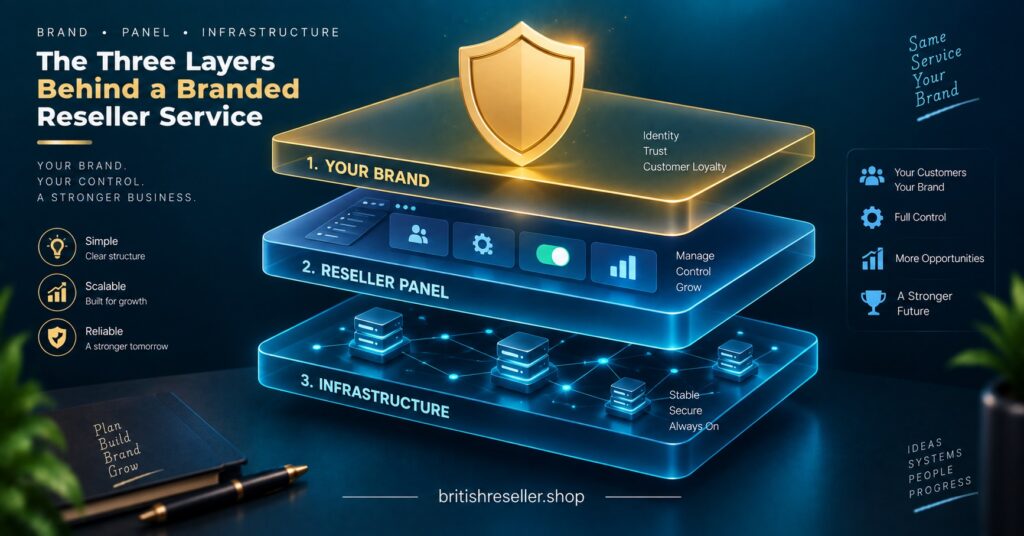
A branded service has several layers, and providers rarely white label all of them. It helps to picture the setup from your subscriber’s side and ask what they see at each step.
The app. This is the most visible layer. A proper branded app shows your name, icon and colours from the moment it is installed. A weaker version is a shared player app where your logo appears after login, which looks fine until a customer searches the app name and finds it listed under someone else.
The connection address. When a customer logs in, the app connects to a server address. If that address uses your own domain, you can repoint it later without asking every customer to reconfigure their device. If it uses the provider’s address, you are tied to them in a way most new resellers do not notice until they want to leave.
The customer portal and billing. Some setups include a client area where subscribers renew, view their account and raise tickets. If that area runs on your domain and takes payments into your account, the customer relationship genuinely belongs to you. If renewals go through the provider’s checkout, it does not.
The reseller dashboard itself. Your subscribers never see this, so branding it matters less. What matters is what it lets you do: create and extend lines, run trials, set connection limits, disable accounts and, where offered, create sub-reseller logins.
Pro tip: Ask the provider for a screenshot of the app’s install screen, login screen and “about” page with a demo brand applied. If the provider’s own name appears on any of them, your customers will find it too.
Ownership Questions Most New Resellers Ask Too Late
The branding question is really an ownership question in disguise. A white label deal is only as good as your ability to keep your customers if the relationship with the provider ends.
Start with the customer data. Can you export your subscriber list, including usernames, expiry dates and contact details, from the dashboard at any time? If the only copy lives on the provider’s side, your business is effectively rented.
Then look at the app listing. If a branded app is published on a major app store, whose developer account holds it? An app published under the provider’s account can be updated, renamed or removed without your input. An app under your own account gives you control, but it also makes you responsible for meeting the store’s policies and keeping it maintained.
Finally, consider credits. Credits are prepaid, so check whether unused credits expire, whether they can be refunded, and what happens to them if your reseller account is suspended. A provider that is vague about this in writing is telling you something.
None of this means a provider-controlled setup is always wrong. For someone testing the market with a small customer base, a simpler arrangement can be sensible. The mistake is assuming you have portability when you do not.
Running a White Label IPTV Reseller Panel UK Business Properly
Putting your name on the service changes your position. When a subscriber has a problem, a complaint or a legal concern, they come to you, because yours is the only name they know. That makes the business side more important, not less.
IPTV is simply a way of delivering television over internet connections, and plenty of legitimate services use it. Whether a particular service is lawful depends on whether the content has been licensed for that distribution. In the UK, selling access to content without the rights holders’ permission can lead to criminal prosecution, and a professional website, a branded app or an ordinary card payment page does not change that. Before signing up with any provider, ask what rights and permissions cover the content you would be reselling, and walk away if the answer is evasive.
On the administrative side, a UK reseller business typically needs to think about:
- Business registration and tax. Operating as a sole trader or a limited company, with income declared to HMRC.
- Data protection. You will hold customer names, emails and payment records, so UK GDPR applies. Most organisations processing personal data must pay the data protection fee to the Information Commissioner’s Office unless an exemption applies, and you will need a privacy notice that reflects what you actually collect.
- Consumer terms. Subscriptions sold online to UK consumers fall under distance-selling rules, so your cancellation and refund terms need to be written with those in mind rather than copied from a provider’s template.
- Your agreement with the provider. Get service levels, credit terms and termination terms in writing, because your customers will hold you to promises the provider may not have made to you.
If any of this feels unfamiliar, a short conversation with an accountant or a solicitor who works with online subscription businesses is money well spent before launch.
Where Branded Setups Tend to Break Down
Most problems with white label arrangements are not dramatic. They show up as small frictions that slowly erode customer trust. These are the points worth settling before your first sale.
| Weak point | How your customers experience it | What to agree before launch |
|---|---|---|
| Server address fixed to provider’s domain | Everyone must reconfigure devices if anything changes | Use of your own domain for connections |
| App held on provider’s store account | App vanishes or gets renamed without warning | Who owns the listing and update schedule |
| Provider branding in support replies | Customer realises they are dealing with a middleman | Unbranded escalation route to provider support |
| Sudden reseller account suspension | All lines stop working at once | Written suspension and notice terms |
| Unclear credit rules | You cannot price renewals with confidence | Credit expiry, refund and conversion terms |
Support deserves special attention. You will usually handle first-line queries yourself: login help, device setup, renewals. Technical faults on the provider’s side need an escalation route. Check how that route works, how quickly it typically responds and whether it can be used without exposing the provider’s name to your subscriber.
Pro tip: Write your own short setup guides for the two or three device types your customers use most. Branded documentation cuts repeat support questions and reinforces that the service is yours.
Questions to Put to a Provider Before Paying
A good provider will answer these clearly and in writing. Vague replies, pressure to buy a large credit bundle quickly, or refusal to discuss content permissions are all reasons to keep looking.
On branding: Is the app fully branded from install to settings, or is branding applied inside a shared app? Can I use my own domain for connections and the customer portal? Is there a one-off branding fee, and does it cover updates?
On control: Can I export my full customer list at any time? Can I set my own trial rules and connection limits? If I create sub-resellers, do they see my branding or the provider’s?
On continuity: What notice do you give before changing prices or terms? What happens to active lines if my account is suspended? How are unused credits handled if I leave?
On legitimacy: What licensing or permissions cover the content delivered through the service? Will you confirm that in writing?
If you are still comparing providers on dashboard features and day-to-day usability, this breakdown of choosing an IPTV reseller panel in the UK covers the operational side in more depth.
Pricing Your Service When Your Name Is on It
Branding changes how you should think about price. A reseller selling unbranded lines competes almost entirely on cost, because customers see no difference between one seller and the next. A branded service can compete on trust, support quality and clarity instead.
That only works if the numbers hold up. Work out your real cost per subscriber: the credit cost for each line, any branding or app fees spread across your expected customer count, payment processing charges, and the time you spend on support. Price from that figure rather than from what other sellers advertise.
Be cautious about undercutting to win early customers. Low prices attract customers who leave the moment someone cheaper appears, and they tend to generate the most support work. Clear terms, a reliable renewal process and prompt replies usually keep customers longer than a small discount.
Pro tip: Keep a simple record of why customers cancel. After a few months it will tell you whether your problem is price, reliability or support, and each needs a different fix.
Frequently Asked Questions
Can I use my own domain for the customer portal?
Many white label packages allow it, but not all. Ask specifically whether both the customer portal and the connection address can run on your domain, as some providers only allow one.
Will my customers ever see the provider’s name?
With a fully branded setup, they should not. Check the app’s about page, error messages, support replies and any emails sent automatically on renewal, since provider names often slip through in those places.
Can I move my subscribers to a different provider later?
Only if you hold the customer data and the connection address uses your domain. Without both, moving usually means asking every customer to set up again from scratch.
Is a branded app included, or charged separately?
It varies widely. Some providers include it with a minimum credit purchase, others charge a setup fee plus ongoing costs for updates. Get the full cost in writing before committing.
Do sub-resellers inherit my branding?
On some panels they do, and on others they see the upstream provider’s interface. If you plan to build a sub-reseller network, confirm this early, because it affects who those sellers feel they are working with.
The Practical Answer
A White Label IPTV Reseller Panel UK arrangement can give you a genuine brand rather than a resold login, but only when the branding goes deeper than a logo. The parts that decide whether the business is really yours are the connection domain, the customer data, the app ownership and the written terms around credits and suspension. Legitimacy matters just as much, because once your name is on the service, so is the responsibility for what it delivers.
The sensible next step is to shortlist two or three providers, send them the questions above, and compare the written answers side by side before spending anything. When you are ready to look at plans and credit options, you can review the British IPTV reseller panel plans and credits available.
Branding Handover Checklist
- Confirm the app shows your brand from the install screen onwards
- Agree in writing that connections can run on your own domain
- Test a full customer data export before your first sale
- Find out whose store account holds the branded app
- Get credit expiry, refund and suspension terms in writing
- Ask for written confirmation of content permissions
- Set up an escalation route that keeps the provider’s name out of customer replies
- Register your business, check the ICO fee and publish a privacy notice
- Write cancellation terms suited to UK online selling