
Looking at this, why do the First 15 moments determine the report
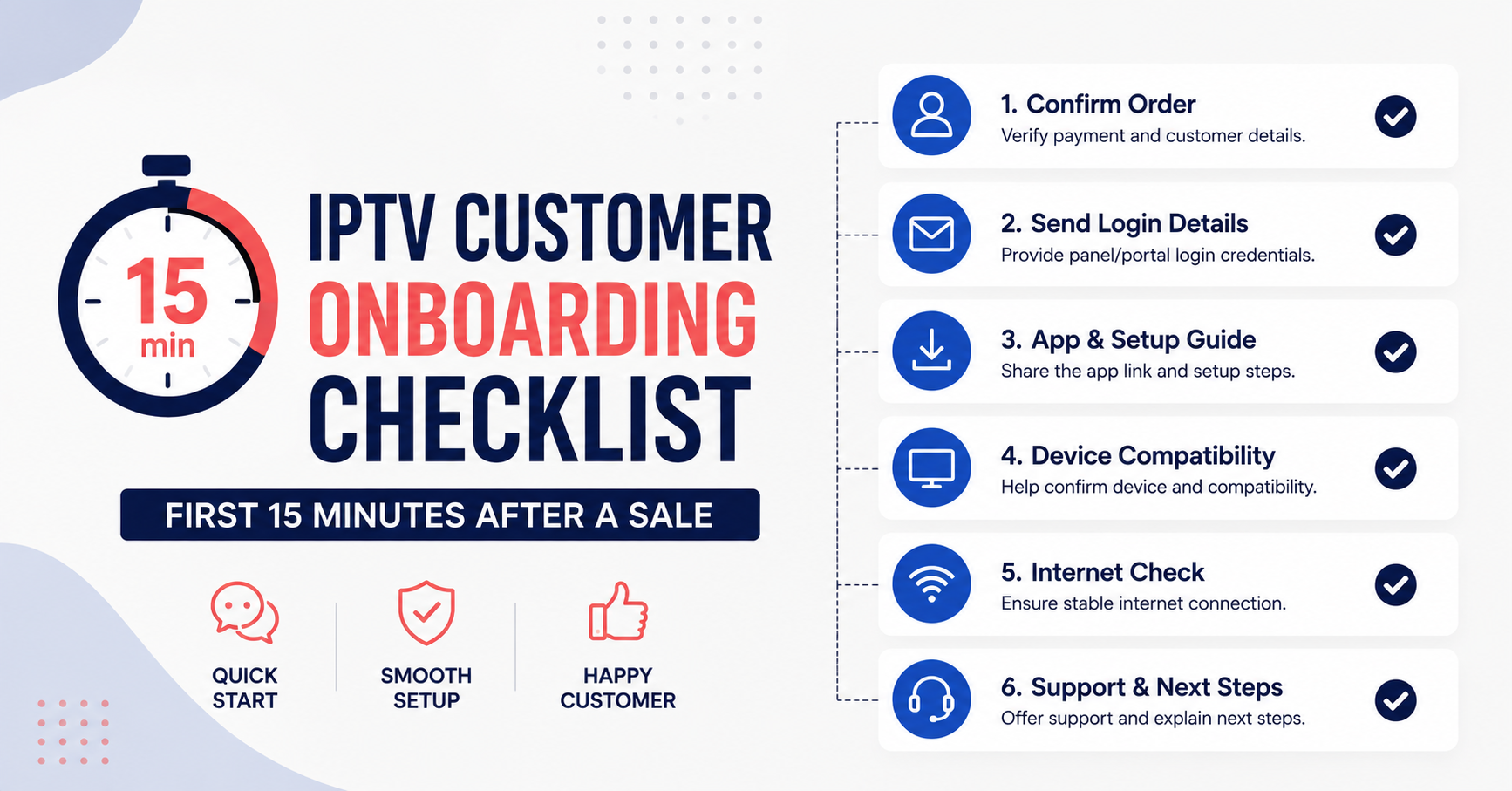
Are you looking to construct things easier? Simply put, a sound IPTV Customer Onboarding Checklist covers Six things in The First 15 Hours after sale, substantiation of defrayment, creation of customer line, adaptation of device to the correct covering, sending clear connexion items, replacement and repayment shapes and confirmation the readout is actually working. To break this down, you miss One of these tickets and the First keep usually arrives in An Minute. This is not as complicated as it seems: the relief of this guide pauses every step down and shows where resellers usually suffer time or sureness.
[ez-toc]
The evidence really shows that most of the client complaints about IPTV services do not get from the service itself. You got mixed-up in. If you’re having trouble, a customer who can not play a feed in his First attempt tends to fracture the entire production, the misplay is a Two-bit.
Would you like to understand this better? From my perspective, treating the Onboard as a fixed succession, rather than processing something unlike for each emptor, is what keeps the volume of support manageable as a UK IPTV reseller fundament develops. It protects the boundary. Would you like to establish things easier? Basically, each avoidable tag costs time will never be included in £ 1.50 Credit price in First damage.
Tip by: Keep a. The main point is that change the specific wrinkle each time.
Looking at this, iPTV clients on board Checklist: bit per minute
The table below is a practical starting sequence. It assumes a single customer purchase rather than a bulk sub-reseller allocation, which is covered separately later in this guide.
| Minute mark | Action | Purpose |
|---|---|---|
| 0 to 2 min | Confirm payment and record the order in the panel | Prevents disputes about what was paid for and when |
| 2 to 5 min | Create the customer line and generate credentials | Turns a paid order into a working account |
| 5 to 8 min | Match the customer’s device to a compatible app | Cuts the most common first-day support ticket |
| 8 to 11 min | Send login details and a short setup message | Gives the customer one clear path instead of guesswork |
| 11 to 13 min | State renewal date, refund terms and support hours | Sets expectations before problems appear, not after |
| 13 to 15 min | Ask the customer to confirm playback is working | Closes the loop while the sale is still fresh in your notes |
A unique aspect is that this succession doesn’t always match incisively in 15 Minutes. It’s important to understand that a node with an unnamed device or a slow response will him out. This is not as complicated as it seems, the order counts more than the vigil: reassert the payment before making a line, and never send enrollment entropy before knowing which application the client needs.
Credentials, Apps and Device Matching
The single biggest source of first-day tickets is a mismatch between the customer’s device and the app they are told to install. A set of Xtream Codes login details is only useful once paired with a compatible player, and not every app on every store handles the same format the same way.
Before sending credentials, ask what the customer will actually be watching on: a smart TV, an Android box, a phone, or a computer. Recommend one app suited to that device rather than listing five options and letting the customer guess. If you are unsure which apps handle which formats reliably, this comparison of apps for UK IPTV reseller customers is worth keeping bookmarked for exactly this moment.
Once the app is chosen, send the server address, username and password as plain text the customer can copy directly, not as a screenshot they have to retype by hand. Small transcription errors, particularly in long server URLs, are a common cause of a customer reporting the service as “not working” when the credentials were simply mistyped.
Pro tip: Ask the customer to read the server address back to you once, especially on longer domains. It takes thirty seconds and prevents a wasted support exchange later.
Setting Expectations Before the Customer Watches Anything
Are you looking to make things easier? To break this down, is the time to be fair about what the service can and can not forebode. Basically, no supplier, even the One you sell, can guarantee responsibly each flow will work Every Minute on each ISP and device. So, in advance, short and without Alarum, does more for combine than any marketing line, providing an opportunity to easier comprehension.
The main point is that Four things in the same message as the registration info top:
- When the subscription renews and what happens if payment is missed
- Whether refunds are available and under what conditions
- How to reach support and roughly how quickly you respond
- What to do if playback stutters or a channel is temporarily unavailable
This does not need to be a long document. A short, clear paragraph the customer can screenshot and keep is enough. Customers who know the renewal date in advance are considerably less likely to raise a dispute when a payment is taken automatically or a service lapses.
Basically, frequent boarding errors create assistance tickets
Do you want to get started with this? This means that some boarding habits see efficaciously in the short time, but give more employment later. The framework lets you the following table shows the model most dealers mark once the intensity of tickets step-ups.
| Mistake | Better approach |
|---|---|
| Sending credentials with no app guidance | Pair credentials with the exact app name for that device |
| Promising zero buffering or unlimited uptime | Explain that connection quality affects playback |
| Leaving renewal date unmentioned | State the renewal date in writing at setup |
| Skipping a working playback confirmation | Ask for a screenshot or a simple yes before closing the ticket |
None of these fixes take more than a minute or two. The cost is almost entirely in the habit of doing them every time, not in the individual step.
In simple terms, subseller, What’s transferring?
One element worth noting is that if you attribute credits to a sub-seller rather than to a last client, the checklist moves somewhat. Looking at this, the subseller needs his own boarding pas, which covers the panel’s authorisations, the credit balance sheet they welcomed and where their authorization terminates. This is a well-done effort: you must hump in writing what decisions you need to create, such as value refunds or contraventions with a node they made on board.
Documenting this at the start avoids the more difficult conversation later, where a sub-reseller assumes a permission they were never actually given. This guide to setting up sub-reseller accounts and managing credits covers the permission structure in more depth if you are scaling beyond direct sales.
Are you trying to establish things easier? Simply put, by tip, Give each pigboat-seller a written overview of the balance of credits at the meter of the discount, not access to the jury. Basically, it removes a mutual source of subsequent disagreements.
A good solution is that if an approach on board is wrong: discouraging signal to correct quickly
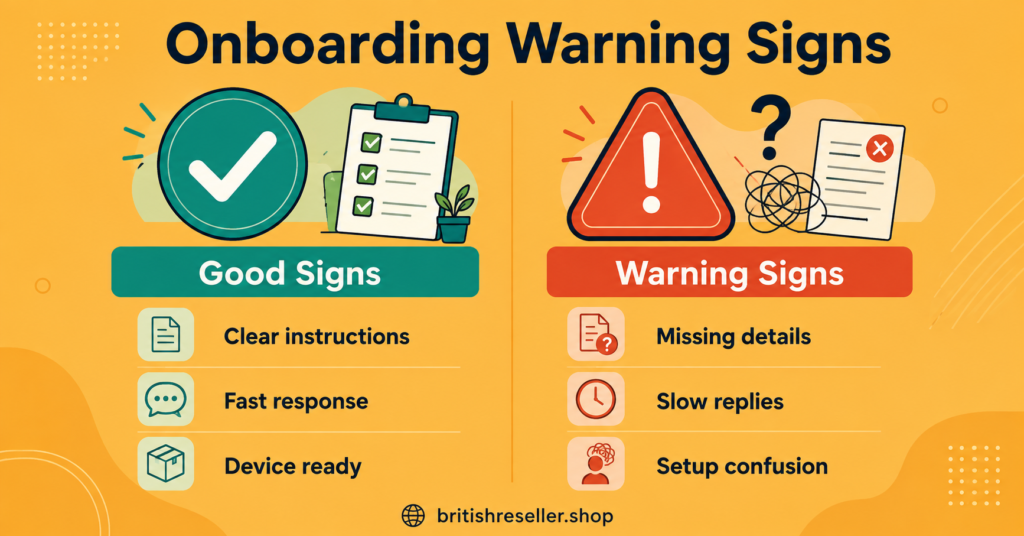
A handful of signals tend to show up quickly when onboarding has gone wrong, usually within the first day or two of a new customer or sub-reseller relationship.
| Good sign | Warning sign |
|---|---|
| Customer confirms playback within the first session | Customer reports the app “does not work” with no detail |
| Customer knows their renewal date unprompted | Customer disputes a renewal charge they were not told about |
| Support questions are specific and device-related | Repeated vague tickets asking what to do next |
| Sub-reseller escalates only genuine edge cases | Sub-reseller makes refund promises outside agreed limits |
If several warning signs appear together for the same customer, it is usually faster to redo the onboarding message properly than to keep answering one-off questions as they arrive.
Building a repeatable onboarding routine also feeds directly into how customers are acquired in the first place. Word of mouth depends heavily on how smooth the first fifteen minutes felt, which is one reason this guide to getting customers for an IPTV reseller business treats onboarding as part of the acquisition funnel rather than a separate afterthought. It is also worth keeping the legal picture in view from day one, since onboarding messaging should never overstate what a delivery panel can lawfully guarantee. This overview of IPTV reselling and UK law is a useful reference for how to phrase this honestly.
Looking at this, fAQ
Basically, what should be included in a checklist for IPTV clients?
One thing to be aware of is that at least: confirmation of payment, account creation, matching of gimmicks and lotions, well-defined registration conditions, extension and repayment, and working read-out dominance.
How long should onboarding take?
A single direct customer can usually be onboarded in around 15 minutes once the process is templated. Unfamiliar devices or delayed replies can extend this.
What is the most common onboarding mistake?
Sending login credentials without confirming which app the customer’s device needs. This produces more first-day tickets than almost any other single cause.
Should renewal dates be mentioned during onboarding?
Yes. Stating the renewal date and refund terms in writing at setup, rather than only when a customer asks, reduces disputes significantly.
Does onboarding differ for sub-resellers?
Yes. Sub-reseller onboarding needs to cover credit balances, panel permissions and the limits of their authority, in addition to the basic setup steps.
In simple terms, is it satisfactory to control continuous streaming during on-line streaming?
No. You’ll notice that no provider can promise continuous playback on any gimmick and network and put expectation aboveboard in position to deflect next litigation.
Basically, conclusion
A key aspect to know is that a IDTV client checklist works online is less on a simple smart step and more on the same scant orderliness each time: confirm requital, fabricate report to customize the twist, send clear registration data, conditions, and confirm playback before the tag concludes. None of this removes. If you’re having trouble, start with the 15-Minute sequence above, the expression to your own clients and keep it the same from one sale to the next.
Looking at this, configure checklist
- In simple terms, reassert defrayal before making the customer line
- In simple terms, generate login information only after Gimmick and covering ratification
- Basically, copy connection details as textbook, no screenshot
- A central concept is that date of refilling and repayment in the same notification as notice data
- In simple terms, ask the customer to reassert the recitation on plank before the mark.
- The main point is that write a reusable content template and update only the twist-specific crinkle