
IPTV Reseller Panel Security really comes down to one question: if somebody else signed into your panel right now, how much could they take before you noticed? In almost every case the answer has nothing to do with clever hacking. It is a password reused from an old email account, a convincing fake login page sent over a messaging app, or a sub-reseller who was handed full permissions because it was quicker than reading the settings. Fix the login layer, restrict what each account can do, and keep customer credentials out of public channels, and you have dealt with most of the realistic risk.
The part resellers underestimate is that panel credits behave like cash and customer lines behave like a client list. Someone inside your dashboard can drain a balance in minutes, but they can also quietly export, resell or reset your customers, which is slower to spot and far harder to recover from. So before you go looking for advanced settings, check the boring things: who knows your password, what device you log in from, and whether anyone else holds an account that can spend your credits.
Why a Stolen Panel Login Hurts More Than a Stolen Password
A compromised email account is annoying. A compromised reseller panel is an operational event, because three separate assets sit behind the same login.
The first is your credit balance, which is prepaid money. The second is your customer base, including usernames, expiry dates and in many panels the credentials themselves. The third is your reputation, because the customers affected will not care who was at fault when their service stops working on a Saturday evening.
There is a fourth cost that gets ignored until it happens. If an intruder mass-creates lines or resets active subscriptions, your supplier sees abnormal activity coming from your account. Depending on the terms you signed, that can lead to a suspension while it is investigated, which means your legitimate customers are offline through no fault of their own. Recovery is not just a password change. It is a support ticket, an audit of every line, and a round of apologies.
The IPTV Reseller Panel Security Checklist for 2026
Work through this in order. The earlier items block far more real-world attacks than the later ones, which is why long security lists that start with obscure settings tend to leave people exposed.
Access and login
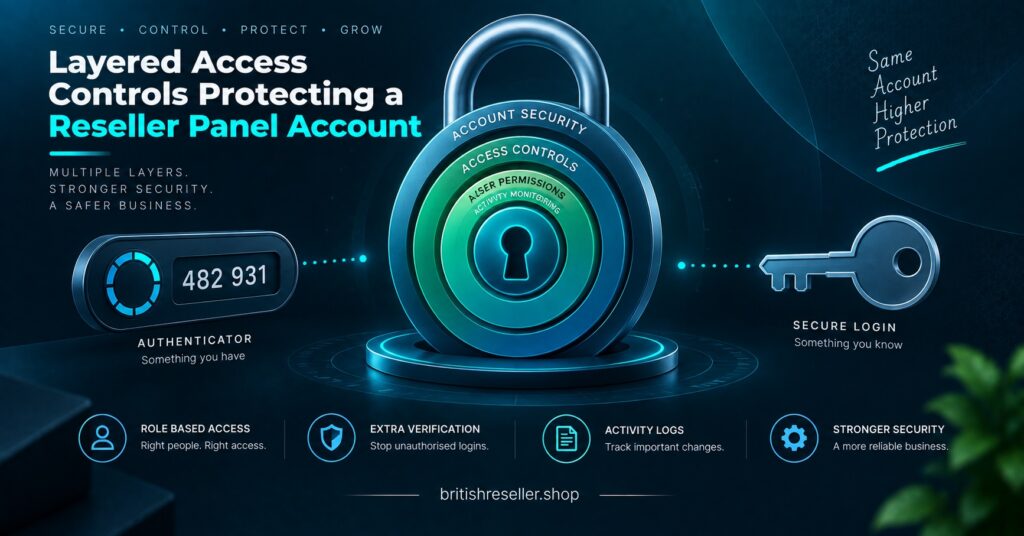
- Use a password that exists nowhere else, generated and stored in a password manager rather than remembered
- Turn on two-factor authentication if the panel supports it, choosing an authenticator app or passkey over SMS codes where you have the option
- Never sign in from a link sent to you in a message or email; type the panel address yourself or use a saved bookmark
- Keep the email address attached to your panel account locked down with its own unique password and second factor, since it is the reset route for everything else
- Log out of shared or borrowed devices instead of relying on the browser to forget
Panel configuration
- Restrict admin access by IP address if the feature is available and your connection is stable enough to make it practical
- Review the account activity or login history regularly so unfamiliar sessions are noticed within days rather than months
- Set sensible connection limits on customer lines so one shared account cannot quietly serve a dozen people
- Keep a private record of your credit balance at the end of each week, so a discrepancy is obvious without relying on the panel alone
Sub-reseller and staff permissions
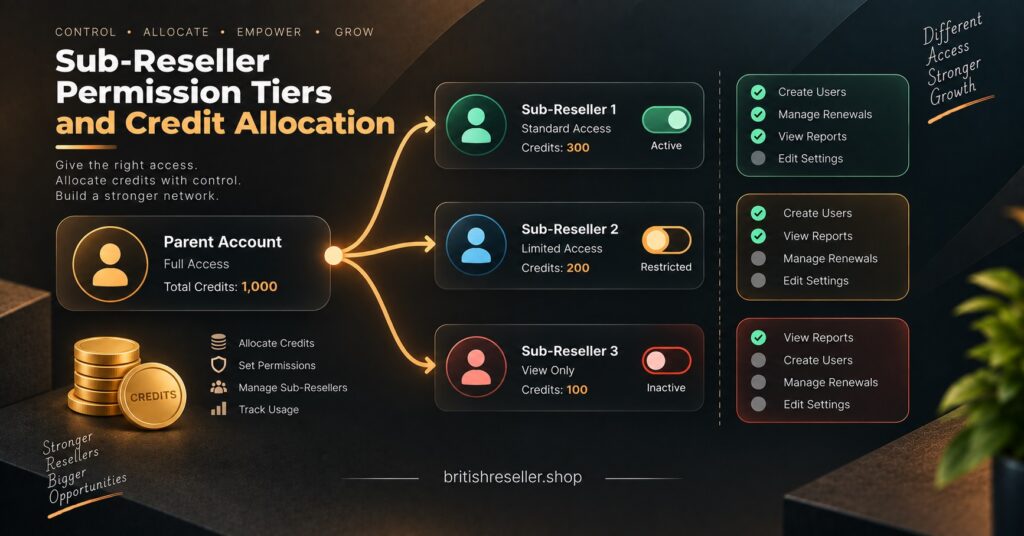
- Give each sub-reseller or staff member their own account; shared logins destroy any ability to trace what happened
- Allocate credits in working amounts rather than dumping your whole balance into a sub-account
- Remove permissions the same day someone stops working with you, not at the end of the month
- Check what a sub-reseller can actually see, particularly whether they can view or edit lines that belong to you
Customer credential handling
- Send credentials through a direct one-to-one channel, never a group chat or public post
- Reset a customer’s password when they report a fault that suggests someone else is using the line
- Avoid sending the full server address, username and password as a single copy-paste block that can be forwarded intact
- Tell customers plainly that you will never ask them to enter their details on a third-party website
Pro tip: Before you change anything else, open your panel’s session or login log and read the last thirty days. If you cannot account for every entry, deal with that first.
The Attacks That Actually Reach Reseller Accounts
Very little of what hits UK IPTV resellers is technically sophisticated. Most of it relies on being in a hurry.
Fake login pages are the most common. A message arrives claiming your panel needs re-verification, your credits are about to expire, or your account has been flagged. The link opens something that looks correct because it was copied from the real thing. You type your details, it fails once, then redirects you to the genuine site where the second attempt works. By the time you notice anything odd, the credentials are already in use.
Support impersonation is the second. Someone contacts you claiming to be from your supplier and asks you to confirm your password, share a screen, or read out a verification code. No legitimate supplier needs your password, and nobody genuine will ever ask you to read them a one-time code.
Then there is the slow leak: customers sharing credentials with friends or family, or a former sub-reseller who kept access and is quietly running lines on your balance. Neither looks like an attack. Both cost money continuously.
| Warning sign | What it usually means | What to do next |
|---|---|---|
| Credit balance lower than your own record | Unauthorized line creation or a sub-account spending freely | Freeze sub-reseller allocations, audit recent line creations, change your password |
| A customer reports frequent disconnections | The line is being used from more locations than it allows | Reset the password, issue new credentials, confirm the agreed device limit |
| Login history shows an unfamiliar location or device | Credentials are in circulation | Change the password, revoke active sessions, enable two-factor authentication |
| Lines you did not create appear in your panel | Another account has write access to your customer list | Contact your supplier immediately and request a permissions review |
| Customers being contacted by someone else offering renewals | Your customer data has been seen by a third party | Audit who has ever had panel access and tighten sub-reseller visibility |
What to Ask Before You Trust a Supplier With Your Customer Base
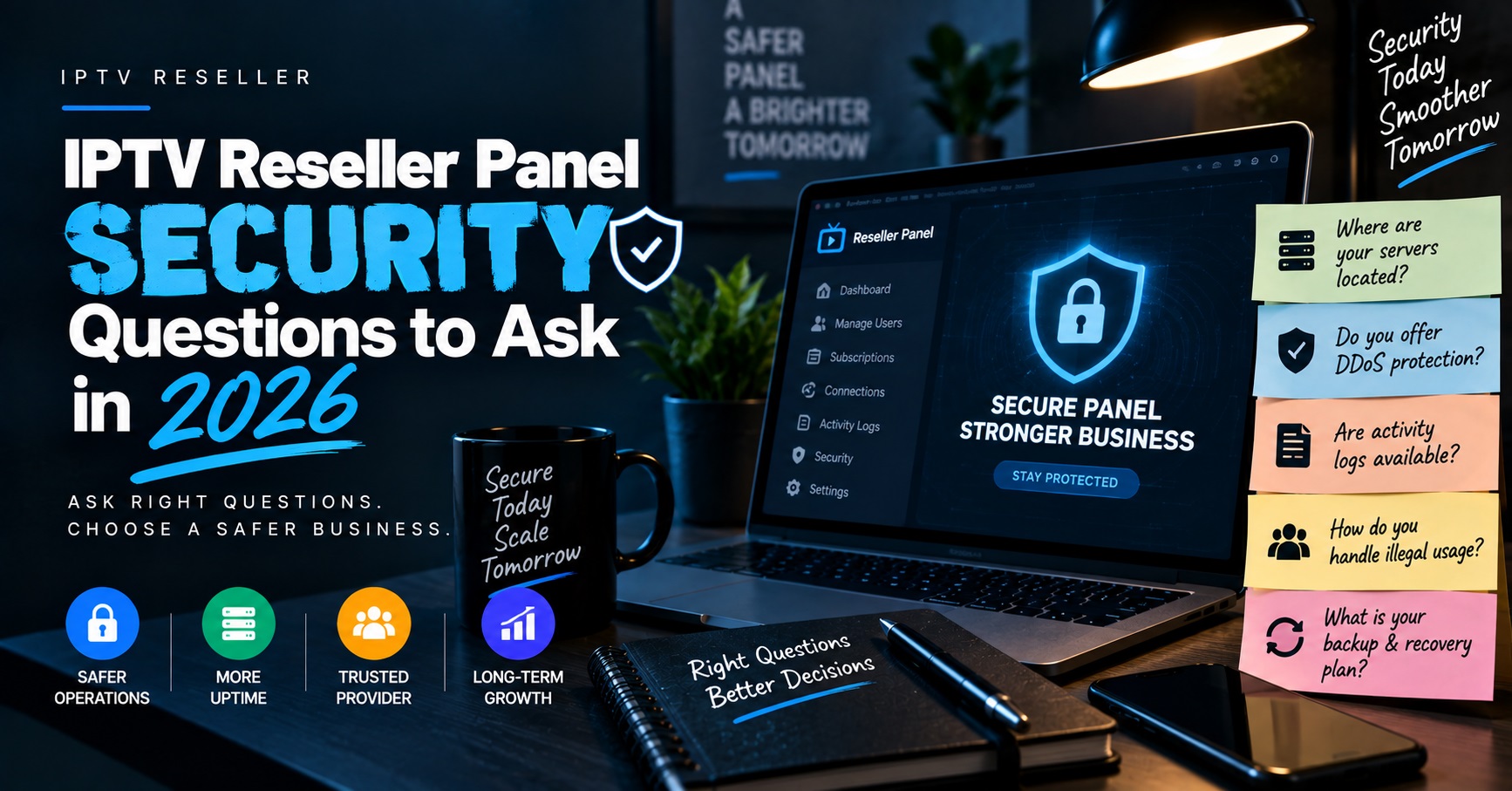
Panel security is not entirely in your hands. Half of it sits with whoever runs the infrastructure, which is why these questions belong in the conversation before you buy credits rather than after something goes wrong.
Ask whether two-factor authentication is available on reseller accounts, and whether it can be enforced on sub-accounts too. Ask what the account recovery process looks like, because a supplier who will reset a password on the strength of a WhatsApp message has effectively removed your security for you. Ask whether the panel keeps a login and action history you can read yourself. Ask what happens to your credits and customer lines if your account is suspended during an investigation, and get the answer in writing.
It is also worth asking how customer credentials are handled at their end and whether support staff can view them. There is no single correct answer, but a supplier who has clearly thought about it will explain their process without hesitating. One who has not will change the subject. If you are still comparing options, the practical criteria in a proper reseller panel comparison guide cover the commercial terms that sit alongside these security questions, and the background on how reseller panels manage customer lines makes it easier to judge whether the permissions on offer are genuinely useful.
If You Think Your Panel Has Been Accessed, Do This in Order
Panic leads people to change the password and stop there, which fixes the entry point and ignores everything the intruder already set up.
- Change your panel password from a device you trust, not the one you suspect might be compromised.
- Change the password on the email account linked to the panel, since that is the reset path back in.
- Enable two-factor authentication if it was not already on.
- End all active sessions if the panel offers that control.
- Suspend or reduce every sub-reseller credit allocation until you have checked them individually.
- Compare your current line list against your own records and note anything you did not create.
- Contact your supplier with dates, times and specifics rather than a general complaint, because that is what allows them to act.
- Only then reissue credentials to affected customers, in small batches, so your support load stays manageable.
Pro tip: Keep an offline record of your customer list, expiry dates and credit purchases. If you ever lose panel access, that file is the difference between a bad week and starting again.
Where Tighter Security Starts Costing You Customers
Security advice tends to assume more is always better. In a reseller business, it is not, because every restriction lands on a paying customer who did not ask for it.
Device locking is the clearest example. It genuinely limits credential sharing, but it also means a customer who replaces a television or changes a router is now waiting on you to unlock the line. If you offer that on a small margin without a fast unlock process, you have created a support queue that eats the margin.
Very low connection limits have a similar effect. A household with two televisions is not abusing anything. Set the limit too tight and you will spend your evenings explaining why the service stopped working in the other room. The sensible position is a limit that matches what you actually sold, communicated clearly at the point of sale, with a documented process for legitimate changes.
The same balance applies to sub-reseller structures. Handing out broad permissions is lazy and risky, but restricting a sub-reseller so heavily that they cannot renew their own customers means you become their support desk. Setting this up properly is a workflow decision as much as a security one, and it is worth reading how sub-reseller accounts and credit allocation are meant to be structured before you start granting access.
Common Questions From Resellers
Does two-factor authentication stop customers sharing their credentials?
No. Two-factor protects your panel login, not the customer lines created inside it. Credential sharing is controlled through connection limits, password resets and clear terms at the point of sale.
Is it safe to manage a reseller panel from a phone?
It is, provided the phone has a screen lock, an up to date operating system, and no third-party apps installed from outside the official store. The bigger phone-specific risk is messaging links, since a fake login page is much harder to spot on a small screen.
What happens to my credits if my account is compromised?
That depends entirely on your supplier’s terms. Some will investigate and restore credits consumed by unauthorised activity, others treat account security as your responsibility. Find out which before you need to know, and keep receipts for every credit purchase.
Should I use the same panel password as my email so I do not forget it?
No, and this is the single most common cause of reseller account compromise. Old data breaches put reused passwords into circulation for years. A password manager removes the need to remember anything.
How can I tell if a former sub-reseller still has access?
Check the panel’s account list rather than assuming removal worked, review recent line creations against your own records, and look at your credit history for allocations you did not authorise. If the panel shows a login history, read it.
Where This Leaves You
IPTV Reseller Panel Security is mostly unglamorous work: a unique password, a second factor, permissions that match what people actually need, and a habit of reading your own login history before something forces you to. None of that takes an afternoon to set up, and it addresses the realistic threats rather than imaginary ones.
Accept that you cannot control everything. Part of your exposure sits with your supplier’s infrastructure, their staff processes and their recovery procedures, which is why the questions above matter more than any setting inside your own dashboard. Where you do have control, use it in proportion, since restrictions that make life difficult for honest customers will cost you more in churn than they save in abuse.
The practical next step is small. Open your panel today, check the login history and the sub-reseller permission list, and write down your credit balance somewhere outside the panel. If either list contains something you cannot explain, you have found your starting point.