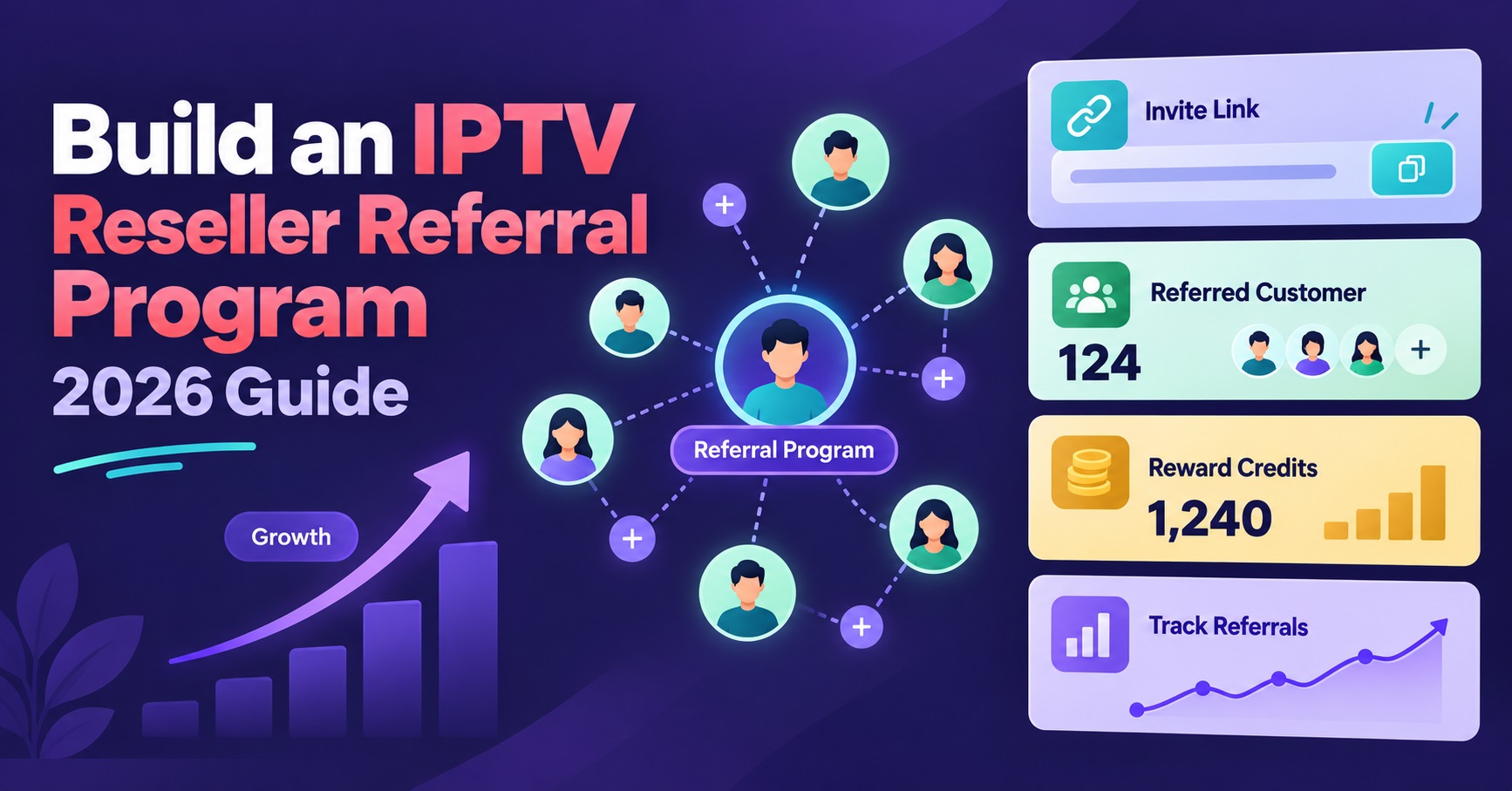

An IPTV reseller referral program is a system where existing customers, sub-resellers or affiliates earn a reward, usually credits, cash commission or a discount, for bringing in verified new business. It only works if the reward is clearly defined, the tracking is reliable, and the terms don’t drift into guaranteed-income or unlicensed-content territory.
What a Referral Program Is Actually Paying For
Most people assume a referral scheme is just “give someone £5 for telling a friend.” In practice, an IPTV reseller panel referral program is paying for one specific outcome: a new paying customer who sticks around long enough to renew at least once. If the reward is triggered purely by a signup rather than a completed, paid subscription, the programme tends to attract low-quality referrals and short-lived trial accounts rather than genuine customers.
There are three broad reward types resellers actually use:
Credit-based rewards, where the referrer receives panel credits they can apply to their own account or a customer’s renewal. This works well if the referrer is already a sub-reseller or an active customer who understands what a credit is worth.
Cash commission, paid per verified referral or as a percentage of the first payment. This is simpler to explain to casual referrers but requires a clean way to track who referred whom, and a defined point at which the referral counts as “verified.”
Discount-based rewards, where both the referrer and the new customer get a reduced renewal price. This tends to suit subscriber-level referrals more than reseller-to-reseller ones, since it rewards loyalty rather than volume.
How to Build an IPTV Reseller Referral Program
Building an IPTV reseller referral program starts with deciding who it’s actually for. A programme aimed at existing subscribers referring friends looks nothing like one aimed at sub-resellers referring other resellers, and mixing the two usually confuses both audiences.
Once the audience is clear, the practical build follows a fairly consistent sequence:
Define the trigger event first. Decide exactly what counts as a qualifying referral, a completed first payment, a second renewal, or something else, and write it down before you tell anyone about the programme.
Pick a reward that matches the audience. Sub-resellers usually respond better to credits they can put straight into their own operation. Subscribers referring friends tend to prefer a simple discount or a small cash reward.
Set a tracking method. A unique referral code, a dedicated link, or a manual note against the new customer’s order all work, but whichever you pick needs to be consistent enough that disputes are rare.
Cap or throttle where needed. Unlimited uncapped rewards can be exploited through repeat sign-ups using the same payment details or duplicate accounts, so most working programmes set a reasonable limit per referrer per month.
Put the terms in writing. Cover what happens on a refund or chargeback, how long a reward stays valid, and whether it can be combined with other promotions.
If your IPTV reseller operation already runs sub-reseller accounts with allocated credits, extending that credit system into a referral reward is usually the least disruptive route, since the accounting mechanism already exists.
Comparing Reward Structures
| Reward type | Works best for | Main limitation |
|---|---|---|
| Panel credits | Sub-resellers and active resellers | Less appealing to casual, one-off referrers |
| Cash commission | Affiliates and word-of-mouth referrers | Needs clean tracking and a payout process |
| Discount on renewal | Subscribers referring friends | Reduces margin rather than adding cash reward |
Pro tip: Set the qualifying trigger at the second payment, not the first. This removes most of the incentive for someone to sign up a friend just once to collect a reward, then let the account lapse.
Staying on the Right Side of Compliance
A referral scheme lives or dies on how it’s worded publicly. Claims like “unlimited earnings,” “guaranteed income” or “get rich reselling” invite scrutiny and rarely survive contact with a genuinely dissatisfied customer. Keep the language factual: state the reward, the qualifying condition, and the limit, and leave it there.
It’s also worth separating the referral incentive from any claim about content legality. Operating a reseller panel is a business and technology activity, and a referral programme rewards customer acquisition, not content rights. If your marketing touches on legality at all, point to a dedicated explanation rather than folding it into the referral pitch. The guide on IPTV reselling and UK law covers this separately, and it’s worth reading before any referral copy goes live.
Common Mistakes That Quietly Undermine a Referral Program
Paying out before the referral has actually converted is the most common one. If the reward triggers on signup rather than a completed, paid month, you’ll pay for accounts that never renew.
Not tracking source data properly is a close second. Without a reliable way to attribute a new customer to a specific referrer, disputes become routine and referrers stop trusting the programme.
Treating the referral programme as a substitute for a real acquisition plan is another. Referrals work best as one channel among several, not the entire customer pipeline. If growth has stalled elsewhere, the broader IPTV reseller marketing strategy for 2026 is a better starting point than pinning everything on referrals alone.
Finally, changing the reward terms retroactively damages trust faster than almost anything else. If the reward structure needs to change, apply it going forward and honour existing commitments.

Pro tip: Keep a simple spreadsheet log of referral code, referrer, date of first payment and date of second payment. It takes minutes to set up and resolves most disputes without argument.
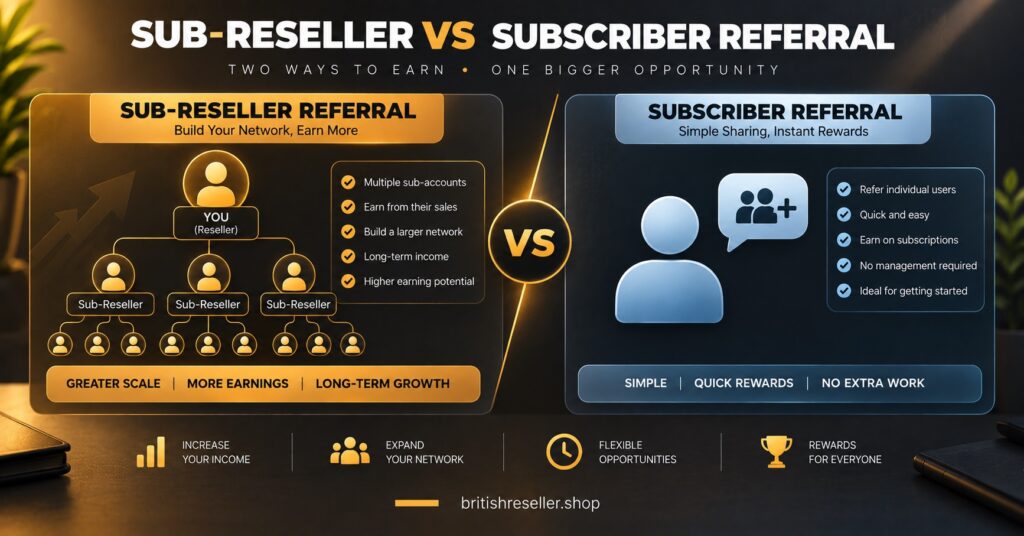
Choosing Between Sub-Reseller and Subscriber Referral Programs
If most of your business comes from other IPTV panel resellers rather than end customers, a sub-reseller referral programme, paying an existing sub-reseller to bring in another one, tends to produce steadier growth because both parties already understand the credit system and the margins involved.
If your business is mostly direct-to-subscriber, a simpler discount-based scheme aimed at existing customers usually performs better, since it doesn’t require the referrer to understand reseller economics at all. Trying to run both models under one set of terms is where most confusion creeps in, so it’s worth writing separate, short terms for each audience rather than one document trying to cover both.
Pro tip: Review referral performance monthly rather than quarterly for the first three months of a new programme. Early data tends to reveal whether the trigger point or reward size needs adjusting before bad habits set in.
Frequently Asked Questions
Should a referral reward be paid on signup or on renewal?
Paying on the second completed payment rather than the initial signup gives a much better indication that the referred customer is genuine and likely to stay.
Can I run a referral program without formal tracking software?
Yes. A simple unique code per referrer, logged manually or in a spreadsheet, is enough for most small to mid-sized reseller operations, provided it’s checked consistently.
Is there a standard commission rate for IPTV reseller referrals?
There’s no fixed industry rate. The reward should reflect your actual margin per customer, not a figure copied from another business with different pricing.
What happens if a referred customer requests a refund?
Most working programmes withhold or claw back the reward if the referred customer refunds or charges back within an agreed window, and this should be stated clearly in the terms before launch.
Can sub-resellers and subscribers use the same referral scheme?
It’s usually cleaner to run separate terms for each group, since sub-resellers respond to credit-based rewards while subscribers generally prefer a straightforward discount.
Bringing It Together
An IPTV reseller panel referral program works when the reward is tied to a genuine, paying customer rather than a bare signup, when tracking is simple enough to be reliable, and when the public terms avoid guaranteed-income language. Start with one audience, either sub-resellers or subscribers, define the trigger point in writing, and review the early results closely before expanding the scheme further. Referrals should support a wider acquisition plan, not replace it.
Referral Program Launch Checklist
- Decide whether the programme targets sub-resellers, subscribers, or runs as two separate schemes
- Define the exact trigger event that qualifies a referral for reward
- Choose a reward type that matches the audience, credits, cash or discount
- Set a tracking method and test it with a dummy referral before launch
- Write refund and chargeback clawback terms into the programme rules
- Set a reasonable cap per referrer to limit abuse
- Publish terms without guaranteed-income or unlimited-earnings language
- Review performance after the first month and adjust the trigger or reward if needed