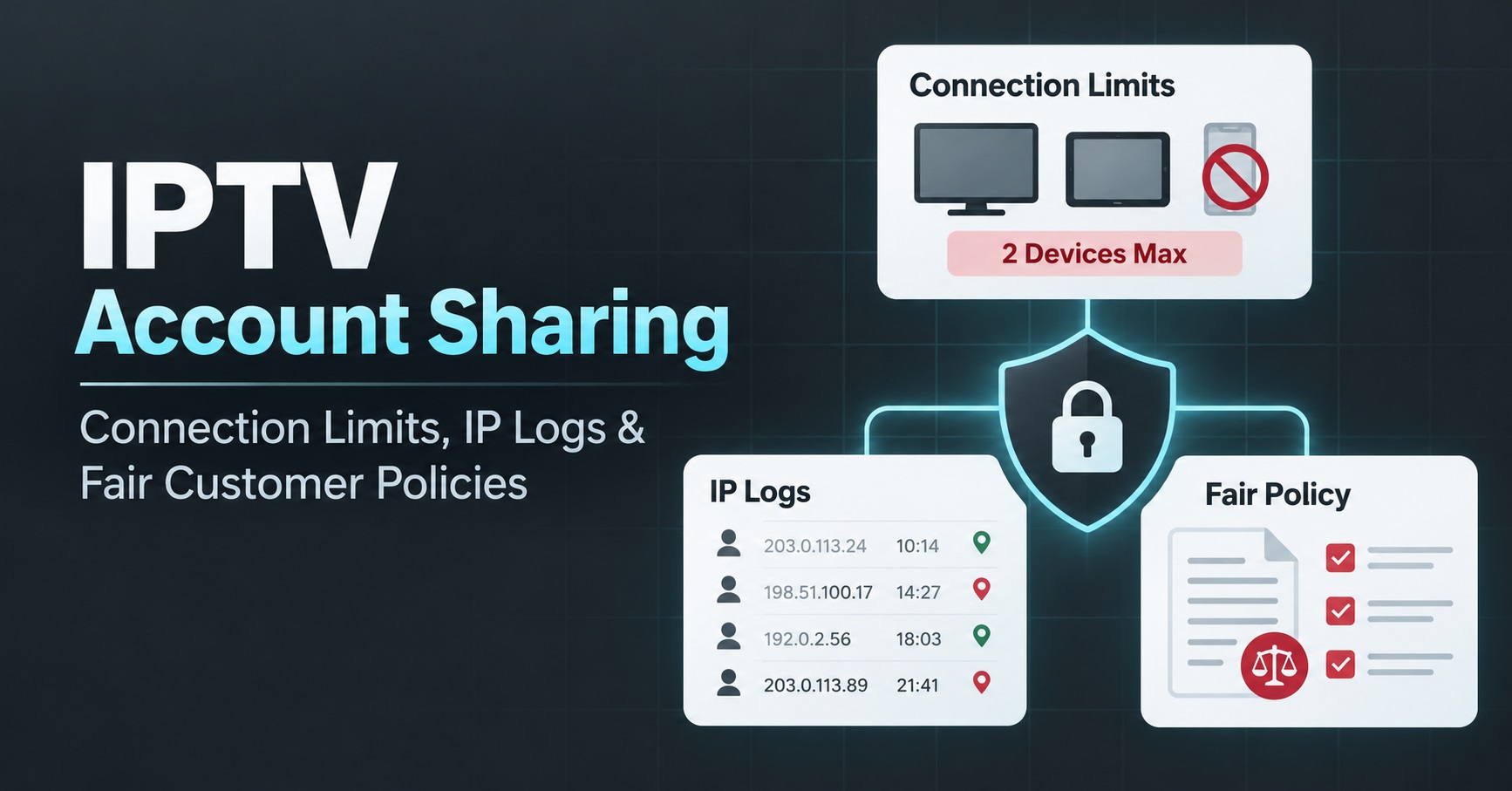

IPTV account sharing is controlled almost entirely by one setting: the number of simultaneous connections a subscription allows. If a line is set to one connection, the second person to open it will be refused or will knock the first viewer off, depending on how the server handles the collision. Nothing about the technology stops a customer from passing their login to a friend. The limit simply decides how many of those people can watch at the same moment. That distinction is the whole subject, and most disputes between resellers and customers happen because neither side understood it before the sale.
What a Connection Limit Actually Controls
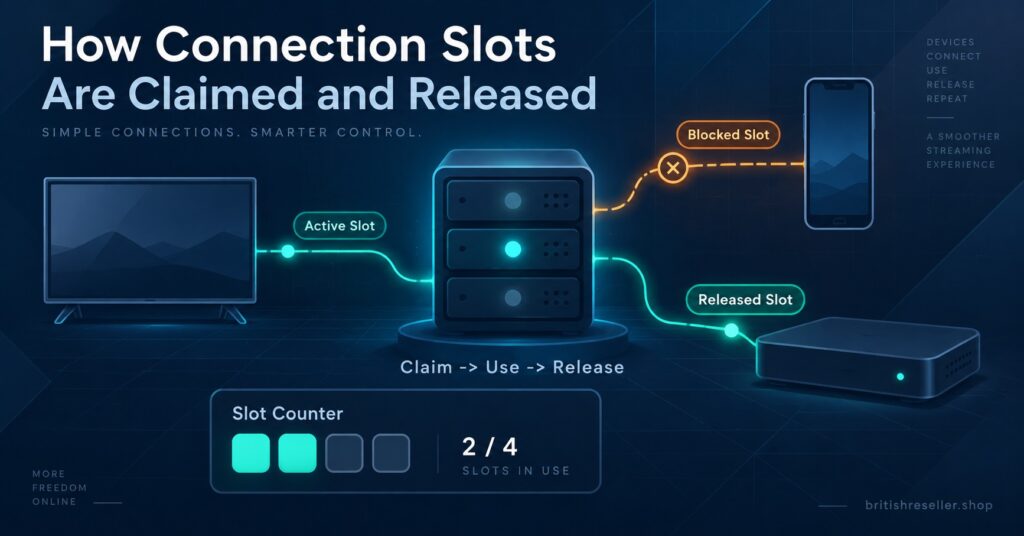
A connection slot is claimed the moment a player authenticates and starts pulling a stream. Release happens when the player closes the stream cleanly. The gap between those two events causes more confusion than deliberate sharing does.
Players do not always exit cleanly. If a customer force-closes an app, loses Wi-Fi mid-stream, or their box freezes, the session can stay open on the server until it times out. The customer then reopens the app, gets a connection-limit error, and contacts you convinced that somebody has stolen their account. In most cases the account is fine and the previous session simply has not expired yet.
Channel switching creates a similar effect. Some players open the new stream before closing the old one, which briefly requires two slots on a single-connection line. A viewer flicking through categories can lock themselves out for a few seconds without ever sharing anything.
Understanding this sequence changes how you handle complaints. Before you accuse anyone of sharing, you need to know whether the panel is showing genuine concurrent viewers or one customer whose session did not close properly. If you are still getting familiar with how the dashboard reports this, the guide to how IPTV reseller panels work covers the basic line controls first.
Pro tip: Before troubleshooting a connection-limit complaint, ask the customer to leave every device off for two full minutes, then try again on one device only. That single step resolves a large share of these tickets without any panel change.
Four Patterns of IPTV Account Sharing You Will Actually See
Sharing is not one behaviour. Treating every case identically is what turns a manageable policy issue into a lost customer or an unpaid support burden.
Household sharing
One paying customer, several people under one roof, several screens. This is the most common form and the least damaging. The viewers are usually in the same time zone, on the same broadband line, and often on the same public IP address. Household use is normal consumer behaviour and your pricing should assume it rather than fight it.
Casual passing on
The customer gives credentials to a relative or a friend elsewhere. Usage now appears from a second network, often at different hours. This is where most resellers feel the pinch, because two households are paying for one subscription and both will contact you for support.
Small-scale redistribution
Credentials circulate through a group chat or a small circle. Connection attempts arrive from many networks and the pattern is erratic. This is the case where your terms need to give you a clear right to suspend the line.
Credential theft
The customer has not shared anything. Their details leaked through a reused password, an untrusted site, or a compromised device. Their behaviour looks identical to redistribution in the logs, which is exactly why logs alone are not a verdict.
The practical consequence of these four patterns is that identical panel evidence can point to completely different situations. Your policy has to give you a proportionate response for each one instead of a single blunt penalty.
What Connection Logs Can and Cannot Prove
Panels typically record the connecting IP address, the timestamp, the user agent or player type, and the active session count. That sounds conclusive. In practice, each field is weaker evidence than it appears.
Most UK residential broadband connections use dynamic addressing, so a customer’s IP can change after a router restart or a line reset. Mobile networks routinely place many subscribers behind shared carrier-grade addresses, meaning two people on the same network can appear at the same address while one person switching between mobile data and home Wi-Fi appears at two different ones within a minute. Anyone using a privacy tool or a corporate network adds another layer that has nothing to do with sharing.
Geographic lookups deserve particular caution. An address database can place a genuine local customer several counties away, or in the wrong country entirely, depending on how the network operator has registered its ranges. Building an accusation on a geolocation result is how resellers lose honest customers.
What the logs are genuinely good at is showing concurrency. Two active sessions on a one-connection line at the same second is a fact, not an interpretation. Sustained concurrency across weeks, on a line sold as single-connection, is the signal worth acting on. Everything softer than that belongs in the “watch and note” category, not the “suspend immediately” category.
| Panel signal | Likely explanation | Sensible next step |
|---|---|---|
| Repeated limit errors from one address | Session not closing cleanly, or fast channel switching | Ask for a two-minute cooldown, then check the player type |
| Two active sessions, same address, evenings | Normal household use on multiple screens | Confirm the plan allows it, upsell a second connection if not |
| Sessions from several networks, same hours | Credentials passed to another household | Send a written reminder of the connection terms |
| Constant sessions from many networks, all hours | Redistribution or leaked credentials | Reset the password, notify the customer, monitor for a week |
| New player type appearing overnight | Device change, or somebody else has the login | Verify with the customer before assuming anything |
Pro tip: Reset the credentials before you suspend the line. A password reset stops unauthorised use immediately and gives an innocent customer their service back within minutes, which a suspension does not.
Where Sharing Quietly Eats Your Margin
The obvious cost is lost revenue: two households, one payment. The less obvious costs are usually larger.
Every extra viewer on a shared line generates support contact, and that contact comes to you rather than to the person paying. You end up guiding someone you have no commercial relationship with through app setup, and you cannot charge for it. Support time is the single most underestimated line in a reseller’s cost model, and shared accounts inflate it without adding a penny of revenue. If you have not yet mapped support hours into your pricing, the pricing and credit calculation guide is a sensible place to start before you change any policy.
Server load is the second cost. Concurrent connections consume capacity regardless of who is paying. Heavy uncontrolled sharing degrades performance for everyone on the same infrastructure, which produces complaints from customers who are doing nothing wrong.
Churn is the third. When a shared line hits its limit during peak viewing hours, the person who suffers is usually the paying customer, not the freeloader. They experience it as an unreliable service and they leave. You lose the subscriber and never learn the real reason.
Set against all this is a genuine counterweight. Households that watch on several screens are your most valuable customers and the least likely to cancel. A policy that treats them as suspects is worse for the business than a policy that quietly prices in a second connection and moves on.
How to Set a Fair Connection Policy
Decide what you are selling before you write the terms
Pick a default and state it in plain words: how many devices may hold the login, and how many may stream at once. Those are two different numbers and conflating them causes most policy arguments. A workable default for a UK consumer product is unlimited installed devices with a capped number of concurrent streams, because that matches how families actually use television.
Publish the limit where the customer will see it
The limit belongs on the sales page, in the order confirmation, and in the setup instructions. A rule that only appears in a terms document nobody opens is unenforceable in practice, whatever it says legally.
Price the second connection instead of policing it
Selling an extra connection as a paid add-on turns a policing problem into revenue. Customers who want two streams will usually pay a modest amount for the certainty rather than risk being cut off mid-programme. This is nearly always more profitable than chasing violations.
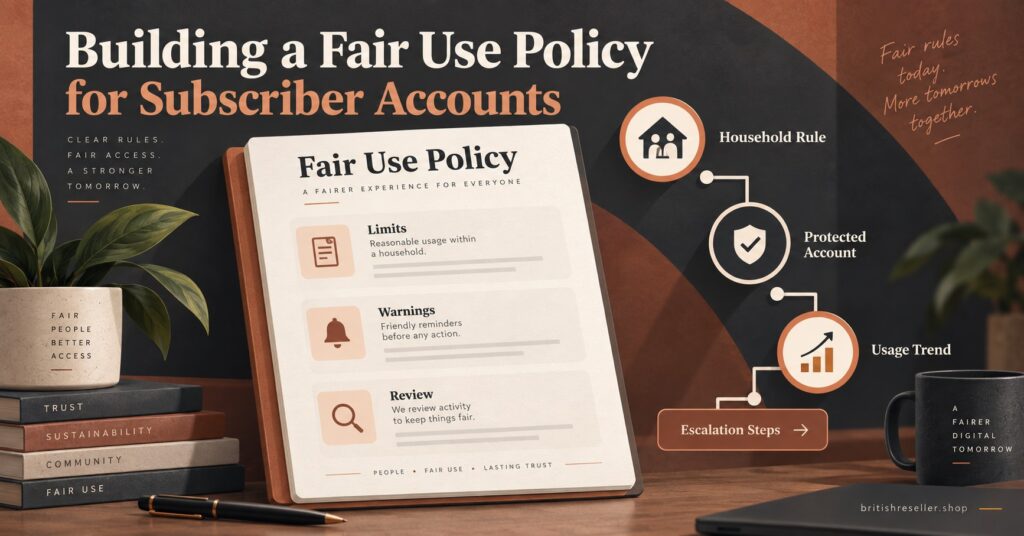
Define your escalation ladder in advance
Write down what happens at each stage: notice, credential reset, temporary suspension, termination. Decide it once, apply it consistently, and record each action against the customer’s record. Inconsistent enforcement is what generates chargebacks and public complaints.
Keep sub-reseller lines under the same rules
If you allocate credits to sub-resellers, their customers inherit whatever policy you fail to specify. Set the connection terms at the point of allocation rather than discovering the problem later. The walkthrough on setting up sub-reseller accounts and managing credits covers the permission side of that arrangement.
Handling the Conversation Without Losing the Customer
Approach every case as a service issue first. Open with the symptom rather than the accusation: their line is hitting its connection limit, here is what that means, here are the options. Most customers will explain the situation themselves at that point, and a fair number will admit to sharing and ask to upgrade.
Avoid quoting IP addresses or locations back at people. It sounds surveillance-heavy, it is often inaccurate for the reasons covered above, and it puts an honest customer on the defensive. Concurrency and timing are enough to make the point.
Give a route out that costs them money rather than access. An offer to add a second connection, or to create a separate line for the other household, converts a confrontation into a sale. Termination should be the last option, reserved for redistribution at a scale that damages your service or your standing with your supplier.
One caution worth stating plainly: a connection policy is a commercial term between you and your customer. It is not a statement about content rights. Whether a stream may lawfully be distributed at all is a separate question that depends on licensing and territory, and it is not resolved by limiting devices. The overview of IPTV panel reselling legality in the UK sets out that distinction properly.
Pro tip: Add one line to your onboarding message: “Your plan includes X simultaneous streams. Extra streams are available at any time, just ask.” Stating the ceiling before problems occur removes almost all of the awkwardness later.
Frequently Asked Questions
Does one credit always mean one device?
No. A credit typically buys a period of service on one line, while the number of simultaneous connections is a separate setting on that line. Two subscriptions can cost the same credits and allow different stream counts, so confirm the connection setting on your package rather than assuming it.
Can two people in the same house watch on different screens at once?
Only if the line permits more than one concurrent connection. Same-household use still consumes separate slots, because the server counts active streams and not addresses. This surprises customers more often than any other rule.
If the same login appears from two cities, is that proof of sharing?
Not on its own. Mobile networks, dynamic broadband addresses and inaccurate geolocation databases all produce that pattern for a single honest viewer. Sustained overlapping sessions carry far more weight than location differences.
Should I sell an extra connection or a second subscription?
An extra connection suits one household with shared payment and shared support. A second line is better when the other party is a separate household, because it gives you a distinct customer, separate credentials and a support relationship you can actually charge for.
What happens if a customer is cut off mid-stream by the limit?
They will usually contact you and describe it as buffering or a service fault. Check the concurrent session count before you investigate anything else, since limit collisions and genuine delivery faults look identical from the sofa.
Can I suspend an account immediately for sharing?
You can if your published terms say so, but it is rarely the best commercial move. A credential reset with a written explanation stops the misuse just as fast and keeps a paying customer who may simply have been careless.
Closing Thoughts
IPTV account sharing is a pricing and policy question far more than a technical one. The server enforces whatever concurrency figure you set, the logs show you overlap rather than intent, and the sensible response is to publish a clear limit, sell additional connections openly, and reserve suspension for cases that genuinely harm your service. The IPTV panel resellers who handle this well are not the ones with the strictest rules. They are the ones whose customers knew the rules before they paid.
If your current terms do not state a connection number, fix that first. Everything else in this article depends on having a figure you can point to.