
Getting customers used to be simple. You ran a Facebook ad, people clicked, people bought. That route has narrowed a lot, and anyone building an IPTV Marketing Strategy 2026 needs to plan around it rather than pretend it still works the old way. Paid social and search ads for IPTV are now treated as high-risk by the platforms that sell them, which pushes real growth toward trust, referrals, content, and retention instead. The good news is that this shift actually rewards IPTV Panel resellers who run things properly, more than it rewards the biggest ad budget.
[ez-toc]
Why an IPTV Marketing Strategy 2026 Looks Different From a Few Years Ago
The old playbook was straightforward. Set up a Facebook page, boost a few posts, run a Google Search campaign, and let the ad account do the heavy lifting. That still works for plenty of industries. It has become genuinely difficult for IPTV.
Meta’s enforcement in 2026 has moved from reacting to obvious rule breaks toward proactively flagging accounts based on behaviour patterns, which means an account can get restricted even without a single ad being reported. Google has also widened its Limited Ad Serving policy so that it now covers Search results directly, capping how often an advertiser’s ads appear once user complaints or quality signals mark the account as unqualified, rather than only applying the cap to newer accounts. Neither of these changes bans IPTV outright, but both make paid reach less predictable than it used to be, and an account that gets restricted mid campaign can cost more in wasted spend than it earns back.
None of this means paid advertising is off the table forever. It means a 2026 strategy cannot lean on it as the only channel, and needs a backup plan that keeps working even if an ad account gets paused for review.
Why Paid Social and Search Ads Are Getting Harder for IPTV Resellers
Ad platforms have long treated IPTV as a high-risk vertical, and that classification has not softened. Campaign approvals can be slow, inconsistent between accounts, and reversed later even after initial approval, which makes it a poor foundation to build an entire customer pipeline on.
If paid ads are part of your plan, treat them as one channel among several rather than the whole strategy. A few practical adjustments reduce risk without pretending the restrictions do not exist:
- Keep your business branding clear and consistent on every ad and landing page, since unclear branding is one of the things platforms flag.
- Avoid vague or generic ad copy. Google’s own advice is to identify your brand clearly rather than let the ad look interchangeable with a dozen others.
- Never rely on a single ad account for your entire customer flow. If it pauses, you still need customers coming in.
Where the Real Growth Is Actually Coming From
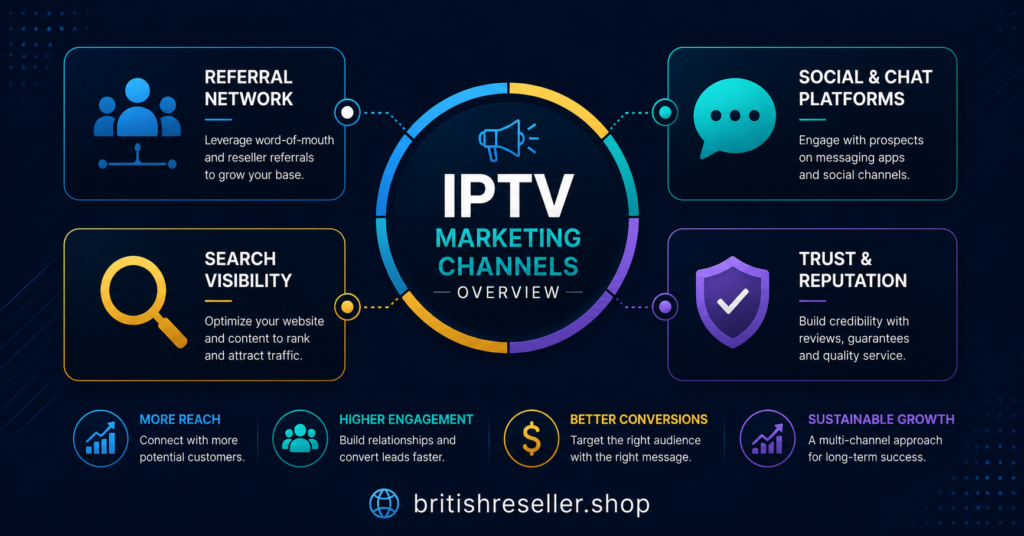
Take away the assumption that a big ad budget wins, and a different picture appears. Resellers who are growing steadily in 2026 tend to lean on channels that do not depend on an ad account staying active.
Referral and word of mouth still convert better than almost anything else for a small IPTV business, because a friend recommending a service carries more weight than an ad ever will. Community groups, both online and local, work the same way when approached honestly rather than as a place to spam links. Search content that answers real questions builds a slow but durable stream of visitors who are already looking for what you sell. None of these channels are instant. All of them keep working even when a platform tightens its rules overnight.
| Channel | Best For | Main Risk |
|---|---|---|
| Referral and word of mouth | Long-term, low-cost growth | Slow to start, needs existing happy customers |
| Community groups and forums | Reaching engaged, relevant people | Bans if it reads as spam rather than participation |
| Search content and blog pages | Compounding organic traffic | Takes months to build, not instant |
| Paid social or search ads | Fast initial reach | Accounts can be restricted with little warning |
| WhatsApp and direct messaging | Fast, personal responses | Only works once you already have contacts |
Pro tip: Before you spend a penny on ads, ask five existing customers if they know anyone who would want the service. That single question often produces better leads than a week of boosted posts.
Building Trust Before You Sell Anything
Marketing an IPTV reseller business is unusual in one respect. The product itself is invisible until someone tries it, so trust has to be earned through everything around it rather than the service alone. That starts with being upfront about what you actually offer, what it costs, and what happens if something goes wrong.
Publish clear pricing rather than “message for price”. Have an actual refund or support policy that a customer can read before they pay, not one you explain only when asked. State plainly what the service is, a subscription management platform for content access, and be honest that legality depends on whether the underlying content is properly licensed rather than making blanket claims either way. Customers researching an IPTV Marketing Strategy 2026 provider list are increasingly checking for exactly this kind of transparency before they commit, because the scam stories around this industry have made people cautious.
Using Free Trials as Your Actual Marketing Engine
A free trial does more selling than any advert, because it removes the only real objection a new customer has, which is not knowing if the service will actually work on their device. Offer a short trial period, set expectations about what it includes, and follow up personally once it ends instead of leaving the customer to decide alone.
Illustrative example only: a panel provider such as Skip This might offer a fixed number of trial slots per UK IPTV reseller account. Whatever provider you use, check the trial allowance, whether it resets, and whether trial customers appear in your dashboard the same way paying customers do, so you can follow up properly rather than losing track of them.
Content and Search Presence That Doesn’t Depend on Ad Accounts
A blog that answers genuine questions, like how IPTV credits work or how to pick between subscription lengths, builds visibility that no platform can pause. This is slower than a paid campaign and it compounds instead of switching off the moment you stop paying.
You do not need to write daily. A handful of genuinely useful pages, updated occasionally, tends to outperform a large volume of thin filler content in search results. If you are short on time, prioritise the pages that answer the questions your existing customers actually ask you, since those are proven questions rather than guesses.
Word of Mouth, Referral, and Local Community Marketing
Structured referral programmes work well in this business because customers already talk to each other about streaming services. A simple reward, a discount on their next renewal for a successful referral, is often enough to turn happy customers into an unpaid sales team.
Local community groups, whether that is a neighbourhood WhatsApp group, a Facebook community, or a forum, can work if you participate genuinely rather than only posting offers. The resellers who get banned from these spaces are usually the ones who show up only to sell. The ones who stay active and answer questions honestly tend to be trusted enough that people ask them directly when they need a service.
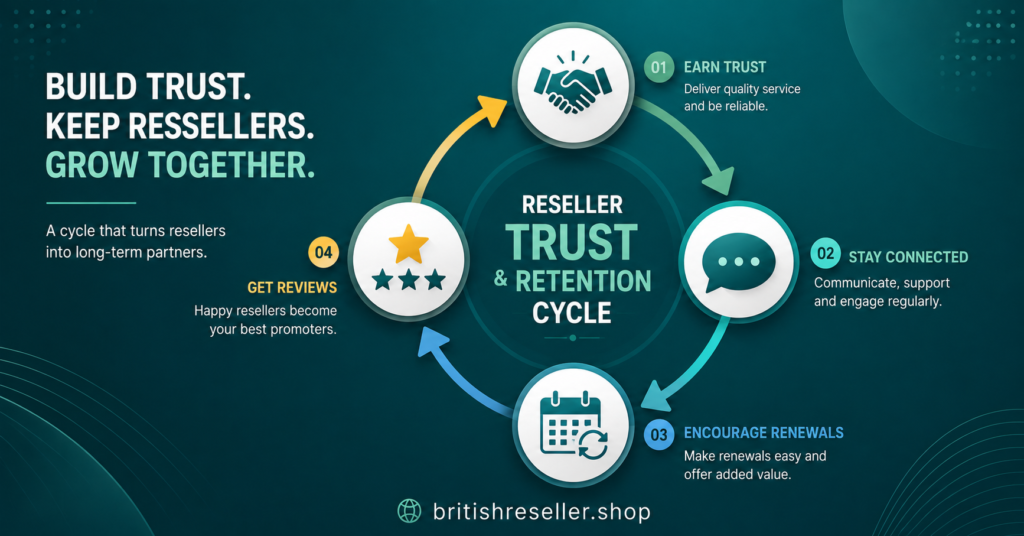
Retention Is a Marketing Strategy Too
New customer acquisition gets most of the attention, but keeping an existing customer for another year is usually cheaper and more reliable than finding a new one. A customer who renews without being chased is worth more marketing effort protecting than a new lead is worth chasing.
| Mistake | Better Approach |
|---|---|
| Only contacting customers when their subscription is about to expire | Check in occasionally, so the renewal message doesn’t feel like the first contact in months |
| Treating every customer the same regardless of value | Recognise long-term customers with small gestures, like an extra free month occasionally |
| Ignoring buffering complaints until they cancel | Investigate connection logs when a customer reports issues, and explain what you found |
| Advertising heavily but never asking for reviews or referrals | Ask satisfied customers directly, most people are happy to help if asked |
Pro tip: Keep a simple note against each customer, when they joined, what they pay, and anything they’ve complained about. It takes minutes and makes every future conversation with them feel personal rather than generic.
What to Ask a Panel or Provider Before You Build Marketing Around Them
Your marketing only works long term if the service behind it holds up. Before committing your marketing budget and reputation to any provider, ask about response times for support, what happens to your credits if you pause selling for a while, and whether connection logs are available so you can actually diagnose a customer’s complaint instead of guessing. This applies equally whatever provider you are considering, whether that is a well known name or something newer like Skip This, since the same questions matter regardless of brand.
Check the IPTV reseller panel overview for a plain explanation of how the reseller side of this actually works before you commit any marketing spend around a specific setup.
A Brief Word for Sub-Resellers
If you’re operating under a parent reseller rather than directly with a provider, your marketing options are usually the same channels, referral, community, content, but your messaging needs to be honest about what you control. Do not promise support response times or feature access that depend on your parent IPTV reseller rather than you. Clarify with them upfront what you’re allowed to promise customers directly, since that avoids awkward conversations later when a customer expects something outside your control.
Growth Checklist
- Confirm your business branding is consistent across every platform before running any paid ads
- Set up a simple referral reward for existing customers rather than relying only on new leads
- Publish clear pricing and support terms instead of “message for details”
- Write a handful of genuinely useful blog pages answering real customer questions
- Track free trial customers separately so none of them get forgotten
- Check in with long-term customers occasionally, not only at renewal time
- Ask satisfied customers directly for reviews or referrals rather than waiting
- Confirm provider support and logging capability before building marketing around them
Frequently Asked Questions
Is paid advertising still worth trying for an IPTV reseller in 2026?
It can work, but it should not be your only channel. Platforms increasingly treat IPTV as high risk, so campaigns can be paused or restricted with little warning. Treat paid ads as a supplement to referral, content, and community growth rather than the foundation.
What’s the fastest way to get my first customers?
Ask people you already know, and offer them a free trial. Personal recommendations convert far better than cold advertising when you’re starting from zero.
Do I need a website to market an IPTV reseller business?
Not strictly, but a simple site with clear pricing and honest information builds trust that a WhatsApp number alone cannot. It also gives you somewhere for search content to live.
How do I market this without breaking platform advertising rules?
Focus on clear branding, honest claims, and channels that don’t rely on paid ad accounts at all, like referral programmes and community participation. Read each platform’s current policy before running paid campaigns, since rules change often.
Should my marketing mention that IPTV legality depends on content licensing?
Yes, being upfront about this builds more trust than avoiding the topic. Customers are increasingly wary of providers who dodge the question entirely.